The Nova Exhibition.
30 Curtain Road, London EC2A 3NZ. Until 14th July.
On entering this exhibition visitors are invited to sit on a wooden bench and watch a 5-minute video of revellers at the Nova Music Festival. On the screen are dancers, mostly young but some middle-aged, quite possibly off their heads with pleasure-giving substances, arms in the air and smiling from ear to ear. They are beaming with joy: joy of the music, joy of each other, joy of life.
Progressing into the main area one soon hears and sees the translation of a phone call: ““Hey Dad. Dad, I’m calling you from Miflasim. Open WhatApp now and see all the murdered. Look how many I killed with my hands. Your son just killed Jews, Dad. This is from Miflasim.” “Allah keep you.” “Dad, I’m calling you from a phone of a Jew. I just killed her and her husband. With my own hands I killed ten! Dad, I killed ten with my hands. Dad, open WhatsApp and see how many I killed.” “Hello?”
Apart from documenting the monumental horrors of that day this exhibition points up the massive cultural difference between the perpetrators of that sickening violence and their victims: people who have grown up to glorify death opposed to those who love life. On another screen a short distance away we see, on the back of a pick-up truck, the partially naked and bloodied body of twenty-two year old Shani Louk, a German-Israeli woman, a declared pacifist. Around her on the truck are four heavily armed men. They are shouting ‘Allahu Akbar’. Her body is being paraded through the streets of Gaza. Gleeful onlookers bang on the sides of the truck and spit on the body.
This important exhibition has already been seen in Toronto, Buenos Aries, Berlin and several US cities. Although it pulls no punches in describing the extent and depths to which the terrorists sunk that day, visually it is more cautious. Video of bodies (a great many were killed in the festival’s stage and bar area) is blurred out to spare us the details.
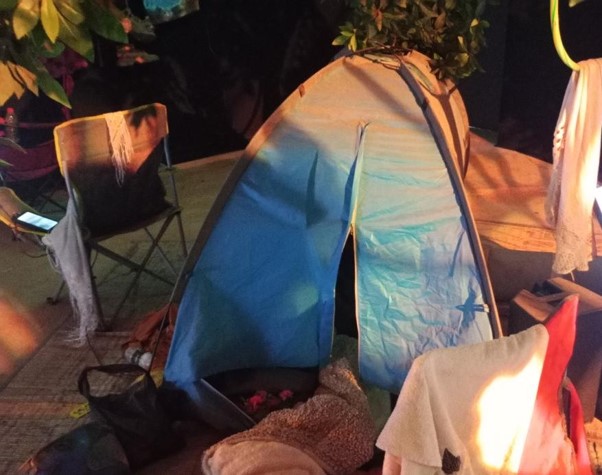
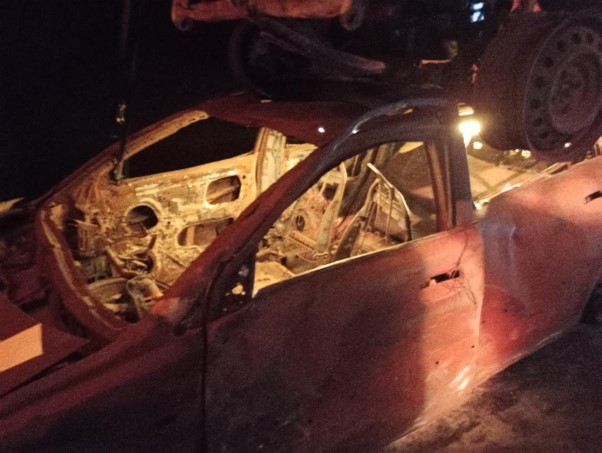
The main part of the show is designed to represent the abandoned camping area with a gritty, partially sandy floor. It is loud and chaotic. Everything displayed is genuine – tents, burned out cars, camping chairs, a backgammon board, clothes hung out to dry. Close to some of the tents are mobile phones which visitors are encouraged to pick up. They play raw video clips recorded by festivalgoers. On one a terrified girl is sending what might be her last message to her parents: “We’re here, in the bush. Hiding from terrorists. It’s fine, don’t be scared. I really want to go home; really hope we can get out of here quickly. I love everyone. I already miss you.” There are several Portaloo’s adorned with the sort of heady, youthful stickers you would expect at a music festival: ‘Live today like there’s no tomorrow.” And then your eye wanders down and you see the six bullet holes which have pierced the door. Adjacent is the shooter’s own body camera footage as he fired his weapon. Tack, tack, tack, tack. No escape, no mercy.
First-hand video testimony from survivors and first responders is crucial in transforming a factual account of the atrocity, much of which we might have read already, into something real, personal and profound. The haunted look in a person’s eyes; the tremor in their voice. A woman relates how she hid inside an ice cream refrigerator. She passed out through lack of air. She came round to hear the voice of another girl who had done the same, but who had been discovered. That girl was pleading for her life. She was shot. A clearly traumatized man, Rami Davidion, a farmer from the area, tells how he arrived at the site to find naked, dead girls spreadeagled and tied to trees. He did his best to cut them down. He managed to fit fifteen young survivors into his five-seater car. He, like countless others, suffers continuing mental ill-health. Shneor Gol was a team leader in Zaka, a volunteer organization tasked with recovering bodies. Truck loads arrived day after day. He states how what was thought to be the charred remains of one person turned out to be that of three, so intense was the fire that had fused them together. It became clear, he says, that if a young couple had been executed by single shots to the head or chest, the gunmen also sprayed the woman’s genital area with bullets, as if to remove the last vestige of her femininity. Many male bodies were recovered with their genitalia cut off.
Towards the end of the exhibition a large screen shows aerial footage of exactly where all 411 festival victims met their deaths. Not just at the festival site, but very tellingly in the fields and along the roads leading away, and in particular in the small concrete bomb shelters built to provide sanctuary in emergencies. In one, crammed with forty people, all but seven perished from gunfire and grenades being lobbed in by cheering fighters. Survival was only possible by playing dead and spending hours under the corpses of one’s friends.
The final section of the show is devoted to the Tribe Nova Foundation which provides ongoing programmes designed to help survivors and bereaved family members to heal and regain their mental well-being. We know that several festival survivors have, since the massacre, taken their own lives.
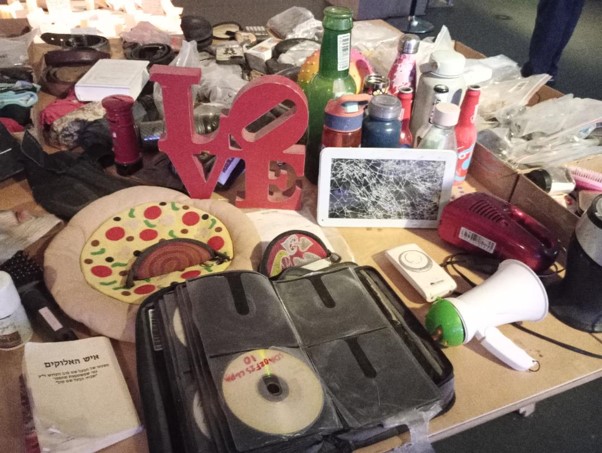
I recommend this exhibition. It is not often that we get a real sense of what lies behind the events brought to us by our usual sources of information. Here, because much what is featured is mundane – abandoned shoes, festival paraphernalia – it comes home with genuine force. The crime which was perpetrated on October 7th, 2023 was not ‘resistance’. It was not political or military action. It wasn’t even terrorism. It was savagery, sadism and depravity.
© Graham Buchan 2026.
The Nova Exhibition.
30 Curtain Road, London EC2A 3NZ. Until 14th July.
On entering this exhibition visitors are invited to sit on a wooden bench and watch a 5-minute video of revellers at the Nova Music Festival. On the screen are dancers, mostly young but some middle-aged, quite possibly off their heads with pleasure-giving substances, arms in the air and smiling from ear to ear. They are beaming with joy: joy of the music, joy of each other, joy of life.
Progressing into the main area one soon hears and sees the translation of a phone call: ““Hey Dad. Dad, I’m calling you from Miflasim. Open WhatApp now and see all the murdered. Look how many I killed with my hands. Your son just killed Jews, Dad. This is from Miflasim.” “Allah keep you.” “Dad, I’m calling you from a phone of a Jew. I just killed her and her husband. With my own hands I killed ten! Dad, I killed ten with my hands. Dad, open WhatsApp and see how many I killed.” “Hello?”
Apart from documenting the monumental horrors of that day this exhibition points up the massive cultural difference between the perpetrators of that sickening violence and their victims: people who have grown up to glorify death opposed to those who love life. On another screen a short distance away we see, on the back of a pick-up truck, the partially naked and bloodied body of twenty-two year old Shani Louk, a German-Israeli woman, a declared pacifist. Around her on the truck are four heavily armed men. They are shouting ‘Allahu Akbar’. Her body is being paraded through the streets of Gaza. Gleeful onlookers bang on the sides of the truck and spit on the body.
This important exhibition has already been seen in Toronto, Buenos Aries, Berlin and several US cities. Although it pulls no punches in describing the extent and depths to which the terrorists sunk that day, visually it is more cautious. Video of bodies (a great many were killed in the festival’s stage and bar area) is blurred out to spare us the details.
The main part of the show is designed to represent the abandoned camping area with a gritty, partially sandy floor. It is loud and chaotic. Everything displayed is genuine – tents, burned out cars, camping chairs, a backgammon board, clothes hung out to dry. Close to some of the tents are mobile phones which visitors are encouraged to pick up. They play raw video clips recorded by festivalgoers. On one a terrified girl is sending what might be her last message to her parents: “We’re here, in the bush. Hiding from terrorists. It’s fine, don’t be scared. I really want to go home; really hope we can get out of here quickly. I love everyone. I already miss you.” There are several Portaloo’s adorned with the sort of heady, youthful stickers you would expect at a music festival: ‘Live today like there’s no tomorrow.” And then your eye wanders down and you see the six bullet holes which have pierced the door. Adjacent is the shooter’s own body camera footage as he fired his weapon. Tack, tack, tack, tack. No escape, no mercy.
First-hand video testimony from survivors and first responders is crucial in transforming a factual account of the atrocity, much of which we might have read already, into something real, personal and profound. The haunted look in a person’s eyes; the tremor in their voice. A woman relates how she hid inside an ice cream refrigerator. She passed out through lack of air. She came round to hear the voice of another girl who had done the same, but who had been discovered. That girl was pleading for her life. She was shot. A clearly traumatized man, Rami Davidion, a farmer from the area, tells how he arrived at the site to find naked, dead girls spreadeagled and tied to trees. He did his best to cut them down. He managed to fit fifteen young survivors into his five-seater car. He, like countless others, suffers continuing mental ill-health. Shneor Gol was a team leader in Zaka, a volunteer organization tasked with recovering bodies. Truck loads arrived day after day. He states how what was thought to be the charred remains of one person turned out to be that of three, so intense was the fire that had fused them together. It became clear, he says, that if a young couple had been executed by single shots to the head or chest, the gunmen also sprayed the woman’s genital area with bullets, as if to remove the last vestige of her femininity. Many male bodies were recovered with their genitalia cut off.
Towards the end of the exhibition a large screen shows aerial footage of exactly where all 411 festival victims met their deaths. Not just at the festival site, but very tellingly in the fields and along the roads leading away, and in particular in the small concrete bomb shelters built to provide sanctuary in emergencies. In one, crammed with forty people, all but seven perished from gunfire and grenades being lobbed in by cheering fighters. Survival was only possible by playing dead and spending hours under the corpses of one’s friends.
The final section of the show is devoted to the Tribe Nova Foundation which provides ongoing programmes designed to help survivors and bereaved family members to heal and regain their mental well-being. We know that several festival survivors have, since the massacre, taken their own lives.
I recommend this exhibition. It is not often that we get a real sense of what lies behind the events brought to us by our usual sources of information. Here, because much what is featured is mundane – abandoned shoes, festival paraphernalia – it comes home with genuine force. The crime which was perpetrated on October 7th, 2023 was not ‘resistance’. It was not political or military action. It wasn’t even terrorism. It was savagery, sadism and depravity.
© Graham Buchan 2026.
By Graham Buchan • exhibitions, photography, video, year 2026 • Tags: exhibitions, Graham Buchan, photography, video