Poetry review – BEYOND THE NINTH WAVE and RED DRESS: Simon Jenner reviews recent collections by Gordon Meade and David Cameron
Beyond The Ninth Wave: Selected Poems
Gordon Meade
Into Poetry ISBN 978-1-73851-49-5-3 £9.99
Red Dress
David Cameron
Greenwich Exchange ISBN 978-1-910996-75-1 £9.99
These two Scottish poets are connected: David Cameron has championed Gordon Meade’s work; they’re also both lucid yet lyrical; and both deploy verse-forms traditional and individual. Cameron uses rhyme, not wholly removed from his near-namesake Norman Cameron, a poet he admires. Unlike that Cameron, however, both poets are intensely personal, addressing themes of locality (particularly Meade), families and losses of all kinds.
 Meade, who is based in the East Neuke of Fife, has produced thirteen short collections since 1991. So a Selected Poems is hardly premature, gathering work published 1991-2023 alongside some uncollected poems. Meade’s sensibility is invested in the coastal world around him, where titles of collections like Singing Seals (1991), The Scrimshaw Sailor (1996) and A Man at Sea (2003) signal their content: though Meade is more complex, even broadly metaphysical.
‘East Neuk Assizes’ opening the collection is an impressive early poem, although a metaphorically atypical one. Its opening is quietly epic: “Sea salt preserves/only the elemental.” Discovering a rotting gull, Meade suggests
A limp-necked shag
takes the stand. Dressed
in bladderwrack and ragworm,
the prosecution’s star witness, says nothing.
Continuing with a ‘Judge’ motif, “A smash-headed/heron… ruffles/his salty gowns to pronounce sentence.” Yet the wider framing of this returns to the elemental and local, here Billow Ness:
The moonstruck sea
gets off with a warning. Her mother,
the hooded moon, is never called.
This establishes coastal themes and casualties, rippling through the first volumes in particular.
Meade’s own identification continues in ‘The Fleet’ where “I see the first ships/returning, bellies laden my head/a net of dreams.” That motif recurs in ‘Hooked’ where after a visceral moment of negative capability as a fish on his father’s hook, Meade flips over the comparison with a neat enjambment: “imagining the pain of being/caught, already hooked on thought.” You can feel the hoik of fish and boy. That continues literally in ‘The Following Through’ with the exhortative refrain from his father “Head down, firm grip, follow through”. Early Heaney might furnish obvious parallels but the experience is insistently the poet’s own.
Thematically Meade begins to broaden in ‘A Gibbous Moon’ written for Wilma, his partner, during her pregnancy. Here the title’s theme diffuses: “while you lie sleeping further/south, our child curled crescent-like inside your womb”; but then deepens as Meade also relates the differences of their origins: himself “a north-east man” while
… you, a south-west woman
covered in mists, full of inlets
…
know also
the land and sea can kiss.
There’s a development too in such poems as ‘The Song of the Raven’ with song ‘a rapid burst from a Kalashnikov’ proceeding in comparisons till it opens out;
…she was the right bird
and at the tight time. A heron would have been far
too spiritual; a crow would not have been enough.
‘The Duckbill Platypus’ with its aggregation of inheritances from each of Meade’s parents uses the kind of pellucid short-lined quatrain that defines one strand of Meade’s later writing. ‘The Dryad’ on mortality and transformation has the poet opt “to turn her into something else” but suggests it would end as he “powerless in the ways of life and death/just stood and watched her die.” This from the mid-point of the collection shows where Meade’s powers settle.
Six later collections (from 2013-23) develop visceral descriptions of animals, slug-slaying (‘Slugs’) though in ‘Hare’ the anthropomorphic (returning to ‘Dryads’) ends “We, whose/spiteful form, will never adorn//the surface of the moon.” In such naturalistic precision, it’s a process easily missed. This is especially true where later poems confront mortality. Nevertheless it’s from The Year of the Crab (2017) onwards that Meade’s greatest achievement stems. A poem entitled ‘Medusa’ introduces the poet’s own struggles with cancer, where being ‘turned to stone’ only radiotherapy can “turn me back into flesh and bone”. Such themes continue in ‘Enter Pursued’ (“by nothing//but fear”) and such specific observations as thickening blood in ‘Read All About It’. Again, in ‘Leaning into the Sharp Points’, “I rush towards them {needles}, arms outstretched”. The powerfully cumulative ‘Macaque’ climaxes with “this is what death looks like/in a cage in a breeding facility in Laos.” ‘Apoptosis’, with its reverse Samaritans role kindly killing cancer, is another sally against death, in a uniquely observed body of work. As Marvell wrote to his nephew. “It is if I dissect myself, and read the anatomy lesson.”
Yet Meade broadens. Addressing the loss of his son-in-law, he moves from the blank grief of ‘Trying to Say Nothing’ to ‘Grief ‘ “This is a poem for another time.” His final, collected poem ‘Almost True’ plays with his sister’s first and last words to him, containing “almost”. Meade’s personal witness stands as a memorial to endurance, grace and some of the finest – and most specific – poems about mortality of recent decades. Meade’s poems before this seem in retrospect a preparation.
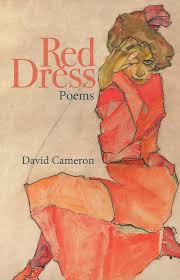 Red Dress is David Cameron’s first collection since Korean Letters (2020). If Cameron here mourns the end of a long relationship, he also shows his wide thematic range, striking out confidently in ways reminiscent of Sidney Keyes; with a sardonic twist ‘What Death Said’ has the poet punning Death to a surreal death: “The organ grinder died of organ failure./Poets stab themselves in the I.” If Death claims “The pun is the sure path to hell” the poet’s “And back” defiantly edges him ahead. Even if he next encounters death at cards with others. It’s a powerful poem down to its last spat-out “Winning!” which doesn’t, despite this, suggest the poet’s inevitable reflexive shudder. He’s an observer.
Cameron’s rhymed quatrains are unobtrusive. And there’s other looser-structured (yet rhymed) autobiographical work that marks this intensely personal tangent from an already-personal poet. There are self-accusations in ‘Slunk Off’ after his partner dropped boiling water on her foot, yet still attended the ball, whereas he sloped off for a pint. Puns weave quietly through rueful years. “The boot’s on the other foot now, you’d say/If you could speak. It hurts like hell, OK?” ‘Gone Before’ is starker, his ex-lover in touch because of illness, cutting through “the usual guff… the honesty was stark.” Indeed language and prosody is too: this is one of the few unrhymed pieces with its pained, blank “Night goes/And night comes back again.” Cameron also shows a Gravesian epigrammatic mastery, as in ‘Kind/Unkind’:
Extremity
Was what drew you to me
More than any kiss.
You have forgotten this.
And in the riddling leanness of ‘Two and Two Together’ he concludes sadly “The two we are equals the two we were./Minus love.”
‘Empire Orwell’ crafts a poem out of a family memory from war. Similarly, poems like ‘The Fire Sermon’ commemorate the revenge firing of Cork in December 1920 by the British Black and Tans. There’s a brief section invoking six women in The Waste Land, ‘The heart of Light’. They’re witty amplifications of female personae, especially in ‘I Can’t Help It’, when Lil’s friend says “‘Look, Lil, at that clean posh gent at the bar.’ /I look. He wouldn’t treat me any better.”
A section of happier, earlier love, only now completed, ‘The Love Below’, still comes with seismic premonition: “I’d rather be a blind boy/Than see you walk away from me.” (Who So You See’). It precedes the final section, ‘Red Dress’ (the title invokes Jodie Foster in ‘Rivalries’). Transmitted trauma, the very early death of Cameron’s father explains to a degree yet never (to the poet) excuses Cameron’s confessions of drunken sprees with friends: ‘Genever’ for instance “Yet you forgave me,/As a young wife whose child/Is barely showing yet/Forgives, cannot forget.” Cameron shows a uncanny capacity to catch shades of pain and guilt: during a wife’s early pregnancy as here.
Yet this section as elsewhere celebrates love, dating the years spent in different countries. ‘Three Rooms’ deploys a ballad-like ruefulness, using the rooms’ colours to differentiate the eroticism of “I knew you in three rooms.” The sheer specificity touches the quirky universal as when reading aloud in ‘Lorca’s Essay’
For what else is dark
But bodies breaking bread
At an intimate supper
Where the guilt is spilled?
The poem ends though: “When I looked up,/You said ‘Don’t stop’”.
This wide-ranging subject-matter lights up corners of a 28-year-relationship, through the casual refraction, say, of Cameron’s wife’s art and glass classes (and a student strike, in ‘The Revolt’). Like that glass, it illuminates the condition of anyone who’s loved deeply and lost. Good examples are the humming of his ex-partner when they and in-laws meet in ‘A Lunch’and the final poem ‘State of Play’, where: “the aching thought of how we were/When love deserved a bolder metaphor.”
Cameron’s poems have also furnished song cycles, and no wonder. His poetry lends itself to setting: not through simplicity, but for presenting complex emotions with memorable clarity. Red Dress proves it’s time we took Cameron even more seriously.
Apr 9 2026
London Grip Poetry Review – Gordon Meade & David Cameron
Poetry review – BEYOND THE NINTH WAVE and RED DRESS: Simon Jenner reviews recent collections by Gordon Meade and David Cameron
Beyond The Ninth Wave: Selected Poems
Gordon Meade
Into Poetry ISBN 978-1-73851-49-5-3 £9.99
Red Dress
David Cameron
Greenwich Exchange ISBN 978-1-910996-75-1 £9.99
These two Scottish poets are connected: David Cameron has championed Gordon Meade’s work; they’re also both lucid yet lyrical; and both deploy verse-forms traditional and individual. Cameron uses rhyme, not wholly removed from his near-namesake Norman Cameron, a poet he admires. Unlike that Cameron, however, both poets are intensely personal, addressing themes of locality (particularly Meade), families and losses of all kinds.
‘East Neuk Assizes’ opening the collection is an impressive early poem, although a metaphorically atypical one. Its opening is quietly epic: “Sea salt preserves/only the elemental.” Discovering a rotting gull, Meade suggests
A limp-necked shag
takes the stand. Dressed
in bladderwrack and ragworm,
the prosecution’s star witness, says nothing.
Continuing with a ‘Judge’ motif, “A smash-headed/heron… ruffles/his salty gowns to pronounce sentence.” Yet the wider framing of this returns to the elemental and local, here Billow Ness:
The moonstruck sea
gets off with a warning. Her mother,
the hooded moon, is never called.
This establishes coastal themes and casualties, rippling through the first volumes in particular.
Meade’s own identification continues in ‘The Fleet’ where “I see the first ships/returning, bellies laden my head/a net of dreams.” That motif recurs in ‘Hooked’ where after a visceral moment of negative capability as a fish on his father’s hook, Meade flips over the comparison with a neat enjambment: “imagining the pain of being/caught, already hooked on thought.” You can feel the hoik of fish and boy. That continues literally in ‘The Following Through’ with the exhortative refrain from his father “Head down, firm grip, follow through”. Early Heaney might furnish obvious parallels but the experience is insistently the poet’s own.
Thematically Meade begins to broaden in ‘A Gibbous Moon’ written for Wilma, his partner, during her pregnancy. Here the title’s theme diffuses: “while you lie sleeping further/south, our child curled crescent-like inside your womb”; but then deepens as Meade also relates the differences of their origins: himself “a north-east man” while
… you, a south-west woman
covered in mists, full of inlets
…
know also
the land and sea can kiss.
There’s a development too in such poems as ‘The Song of the Raven’ with song ‘a rapid burst from a Kalashnikov’ proceeding in comparisons till it opens out;
…she was the right bird
and at the tight time. A heron would have been far
too spiritual; a crow would not have been enough.
‘The Duckbill Platypus’ with its aggregation of inheritances from each of Meade’s parents uses the kind of pellucid short-lined quatrain that defines one strand of Meade’s later writing. ‘The Dryad’ on mortality and transformation has the poet opt “to turn her into something else” but suggests it would end as he “powerless in the ways of life and death/just stood and watched her die.” This from the mid-point of the collection shows where Meade’s powers settle.
Six later collections (from 2013-23) develop visceral descriptions of animals, slug-slaying (‘Slugs’) though in ‘Hare’ the anthropomorphic (returning to ‘Dryads’) ends “We, whose/spiteful form, will never adorn//the surface of the moon.” In such naturalistic precision, it’s a process easily missed. This is especially true where later poems confront mortality. Nevertheless it’s from The Year of the Crab (2017) onwards that Meade’s greatest achievement stems. A poem entitled ‘Medusa’ introduces the poet’s own struggles with cancer, where being ‘turned to stone’ only radiotherapy can “turn me back into flesh and bone”. Such themes continue in ‘Enter Pursued’ (“by nothing//but fear”) and such specific observations as thickening blood in ‘Read All About It’. Again, in ‘Leaning into the Sharp Points’, “I rush towards them {needles}, arms outstretched”. The powerfully cumulative ‘Macaque’ climaxes with “this is what death looks like/in a cage in a breeding facility in Laos.” ‘Apoptosis’, with its reverse Samaritans role kindly killing cancer, is another sally against death, in a uniquely observed body of work. As Marvell wrote to his nephew. “It is if I dissect myself, and read the anatomy lesson.”
Yet Meade broadens. Addressing the loss of his son-in-law, he moves from the blank grief of ‘Trying to Say Nothing’ to ‘Grief ‘ “This is a poem for another time.” His final, collected poem ‘Almost True’ plays with his sister’s first and last words to him, containing “almost”. Meade’s personal witness stands as a memorial to endurance, grace and some of the finest – and most specific – poems about mortality of recent decades. Meade’s poems before this seem in retrospect a preparation.
Cameron’s rhymed quatrains are unobtrusive. And there’s other looser-structured (yet rhymed) autobiographical work that marks this intensely personal tangent from an already-personal poet. There are self-accusations in ‘Slunk Off’ after his partner dropped boiling water on her foot, yet still attended the ball, whereas he sloped off for a pint. Puns weave quietly through rueful years. “The boot’s on the other foot now, you’d say/If you could speak. It hurts like hell, OK?” ‘Gone Before’ is starker, his ex-lover in touch because of illness, cutting through “the usual guff… the honesty was stark.” Indeed language and prosody is too: this is one of the few unrhymed pieces with its pained, blank “Night goes/And night comes back again.” Cameron also shows a Gravesian epigrammatic mastery, as in ‘Kind/Unkind’:
Extremity
Was what drew you to me
More than any kiss.
You have forgotten this.
And in the riddling leanness of ‘Two and Two Together’ he concludes sadly “The two we are equals the two we were./Minus love.”
‘Empire Orwell’ crafts a poem out of a family memory from war. Similarly, poems like ‘The Fire Sermon’ commemorate the revenge firing of Cork in December 1920 by the British Black and Tans. There’s a brief section invoking six women in The Waste Land, ‘The heart of Light’. They’re witty amplifications of female personae, especially in ‘I Can’t Help It’, when Lil’s friend says “‘Look, Lil, at that clean posh gent at the bar.’ /I look. He wouldn’t treat me any better.”
A section of happier, earlier love, only now completed, ‘The Love Below’, still comes with seismic premonition: “I’d rather be a blind boy/Than see you walk away from me.” (Who So You See’). It precedes the final section, ‘Red Dress’ (the title invokes Jodie Foster in ‘Rivalries’). Transmitted trauma, the very early death of Cameron’s father explains to a degree yet never (to the poet) excuses Cameron’s confessions of drunken sprees with friends: ‘Genever’ for instance “Yet you forgave me,/As a young wife whose child/Is barely showing yet/Forgives, cannot forget.” Cameron shows a uncanny capacity to catch shades of pain and guilt: during a wife’s early pregnancy as here.
Yet this section as elsewhere celebrates love, dating the years spent in different countries. ‘Three Rooms’ deploys a ballad-like ruefulness, using the rooms’ colours to differentiate the eroticism of “I knew you in three rooms.” The sheer specificity touches the quirky universal as when reading aloud in ‘Lorca’s Essay’
For what else is dark
But bodies breaking bread
At an intimate supper
Where the guilt is spilled?
The poem ends though: “When I looked up,/You said ‘Don’t stop’”.
This wide-ranging subject-matter lights up corners of a 28-year-relationship, through the casual refraction, say, of Cameron’s wife’s art and glass classes (and a student strike, in ‘The Revolt’). Like that glass, it illuminates the condition of anyone who’s loved deeply and lost. Good examples are the humming of his ex-partner when they and in-laws meet in ‘A Lunch’and the final poem ‘State of Play’, where: “the aching thought of how we were/When love deserved a bolder metaphor.”
Cameron’s poems have also furnished song cycles, and no wonder. His poetry lends itself to setting: not through simplicity, but for presenting complex emotions with memorable clarity. Red Dress proves it’s time we took Cameron even more seriously.