Extreme Private Eros: Love Song 1974 (Kazuo Hara)
Second Run Blu Ray
Miyuki is bi-sexual. The opening scenes of Extreme Private Eros: Love Song 1974 shows Miyuki with her female lover Sugako who cannot verbally express her feelings about their relationship. They live in a small town near a US military base in Okinawa and both work in a bar frequented by black American GIs. Miyuki and Sugako split up. Miyuki has a relationship with a male soldier. This is very brief. Miyuki becomes pregnant and eventually has her mixed race baby. Afterwards she joins a women’s refuge and assists with the birth of a child by a young resident. Throughout all her experiences Miyuki exudes a tough individualism that’s remarkable for its extreme self-sufficiency and defiant courage.
In this extraordinary documentary the director Kazuo Hara visits his ex-girl friend Miyuki to film her giving birth completely unassisted at home on a mattress littered with plastic sheeting and newspaper. Hara’s new partner kneels by Miyuki’s side with a microphone recording Miyuki’s reactions to the pain and joy of labour. The raw graphic power of this scene is unique in cinema. Perhaps only a few medical establishment films in 1974 might have filmed this act but they would have certainly been assisted births with a midwife. Certainly no feature films had realistically attempted this. And even to this day the sequence is unequalled in world cinema for its uncompromising matter of fact power.
Kazuo Hara has described his method as “action documentary”. He attacks his material with an almost aggressive intimacy. There’s no political agenda here but more the placing of a radical trust – letting his strong willed subjects speak for themselves, both affirming those who critique societal norms of family, Extreme Private Eros: Love Song 1974 or expose cruel military behaviour The Emperor’s Naked Army Marches On – Hara’s 1987 documentary.
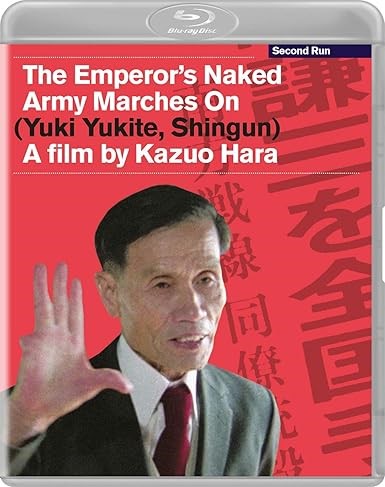
(I watched the masterly The Emperor’s Naked Army Marches On, also on Second Run Blu Ray, and was struck by the strong will of its subject Kenzo Okuzaki a WW2 veteran who blames the Emperor Hirohito for the barbarous end to the war when soldiers were shot, on false grounds of desertion, and then cannibalised by the starving few left in Okuzaki’s regiment. His determination to find those responsible for issuing such orders pushes him over into violence when he encounters evasion and lies. Miyuki and Okuzaki are very different characters yet what binds them is their determined truth seeking: Miyuki the man on a mission and Miyuki the instinctual feminist.)
Technically Extreme Private Eros: Love Song 1974 is rough. It was shot with very basic equipment on a micro-budget. Often speech is out of synch and the birth scene is unfocused owing to Hara’s nervousness at shooting the scene. Was the camera deliberately out of focus or accidently so given his fears and apprehension? Does that matter? I think an audience being unsure with a sensitive unsure director can create a more pointed reality, a filmic document discovering truth in the moment.
Godard often praised the ambiguity of things going ‘wrong’ in filmmaking as it allowed the arbitrary incident to exist in a cinema that shouldn’t be over-planned. And when at moments speech in Eros is technically disembodied it strangely adds to the brute realism of the narrative where what’s being said appears to be what’s being thought, all reinforced by the tight intimacy of a film with its camera bearing the responsibility of being an observer and recorder in a complex set of sexual relationships.
In Miyuki’s free time from the refuge we see her going back to the club to dance seemingly happily topless for the GI crowd. Okuzaki is eventually jailed for shooting the son of the officer responsible for the executions. They appear to naturally assert their ‘freedom’ and accept responsibility for it.
Kazuo Hara (still alive and now 80) is an authentic radical of documentary cinema. And both of these amazing, if painful, films ask deep questions about sexual identity, the family, individual freedoms, guilt, responsibility, retribution and how to achieve, whether rightly or wrongly, an intense and very personal liberation you can comfortably accommodate.
Alan Price©2026.
Extreme Private Eros: Love Song 1974 (Kazuo Hara)
Second Run Blu Ray
Miyuki is bi-sexual. The opening scenes of Extreme Private Eros: Love Song 1974 shows Miyuki with her female lover Sugako who cannot verbally express her feelings about their relationship. They live in a small town near a US military base in Okinawa and both work in a bar frequented by black American GIs. Miyuki and Sugako split up. Miyuki has a relationship with a male soldier. This is very brief. Miyuki becomes pregnant and eventually has her mixed race baby. Afterwards she joins a women’s refuge and assists with the birth of a child by a young resident. Throughout all her experiences Miyuki exudes a tough individualism that’s remarkable for its extreme self-sufficiency and defiant courage.
In this extraordinary documentary the director Kazuo Hara visits his ex-girl friend Miyuki to film her giving birth completely unassisted at home on a mattress littered with plastic sheeting and newspaper. Hara’s new partner kneels by Miyuki’s side with a microphone recording Miyuki’s reactions to the pain and joy of labour. The raw graphic power of this scene is unique in cinema. Perhaps only a few medical establishment films in 1974 might have filmed this act but they would have certainly been assisted births with a midwife. Certainly no feature films had realistically attempted this. And even to this day the sequence is unequalled in world cinema for its uncompromising matter of fact power.
Kazuo Hara has described his method as “action documentary”. He attacks his material with an almost aggressive intimacy. There’s no political agenda here but more the placing of a radical trust – letting his strong willed subjects speak for themselves, both affirming those who critique societal norms of family, Extreme Private Eros: Love Song 1974 or expose cruel military behaviour The Emperor’s Naked Army Marches On – Hara’s 1987 documentary.
(I watched the masterly The Emperor’s Naked Army Marches On, also on Second Run Blu Ray, and was struck by the strong will of its subject Kenzo Okuzaki a WW2 veteran who blames the Emperor Hirohito for the barbarous end to the war when soldiers were shot, on false grounds of desertion, and then cannibalised by the starving few left in Okuzaki’s regiment. His determination to find those responsible for issuing such orders pushes him over into violence when he encounters evasion and lies. Miyuki and Okuzaki are very different characters yet what binds them is their determined truth seeking: Miyuki the man on a mission and Miyuki the instinctual feminist.)
Technically Extreme Private Eros: Love Song 1974 is rough. It was shot with very basic equipment on a micro-budget. Often speech is out of synch and the birth scene is unfocused owing to Hara’s nervousness at shooting the scene. Was the camera deliberately out of focus or accidently so given his fears and apprehension? Does that matter? I think an audience being unsure with a sensitive unsure director can create a more pointed reality, a filmic document discovering truth in the moment.
Godard often praised the ambiguity of things going ‘wrong’ in filmmaking as it allowed the arbitrary incident to exist in a cinema that shouldn’t be over-planned. And when at moments speech in Eros is technically disembodied it strangely adds to the brute realism of the narrative where what’s being said appears to be what’s being thought, all reinforced by the tight intimacy of a film with its camera bearing the responsibility of being an observer and recorder in a complex set of sexual relationships.
In Miyuki’s free time from the refuge we see her going back to the club to dance seemingly happily topless for the GI crowd. Okuzaki is eventually jailed for shooting the son of the officer responsible for the executions. They appear to naturally assert their ‘freedom’ and accept responsibility for it.
Kazuo Hara (still alive and now 80) is an authentic radical of documentary cinema. And both of these amazing, if painful, films ask deep questions about sexual identity, the family, individual freedoms, guilt, responsibility, retribution and how to achieve, whether rightly or wrongly, an intense and very personal liberation you can comfortably accommodate.
Alan Price©2026.
By Alan Price • added recently on London Grip, film • Tags: Alan Price, film