WAYWARD THOUGHTS – Pat Edwards reviews a poetry and lute collaboration by Cheryl Moskowitz and Sam Brown
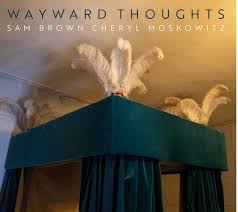
This was a very different assignment for me to review and one which was a delightful challenge. The whole experience of listening to this collaborative work felt intimate and contemplative. It forced me to be still a while and to consider just what the poet and lutenist were striving to achieve.
The music is nearly all from the turn of the sixteenth century, spanning composers who lived during the reigns of Elizabeth 1 and James 1. Despite being played by a solo musician, the music sounds very layered and at times complex. Tonally, it is very easy on the ear, crisp, concise, virtuoso. The poetry, by contrast, feels much more contemporary and references themes, places, and imagery we readily associate with twenty first century life. The relationship between a musician and their instrument is as mysterious as that between a poet and the page, something at the same time sacred and intensely surreal. This makes for a fascinating blend of words and music.
The piece opens with lines from Kahill Gilbran’s ‘The Prophet.’ This Lebanese-American poet lived from 1883 -1931 and the quotation suggests that “your joy is your sorrow unmasked.” Such an idea is evident throughout the work, which explores big themes including life, love, nature, death and renewal. The first poem by Moskowitz considers the Islamic myth which attributes the invention of the lute or oud to a father grieving the loss of his son. The descriptions of trees and wood and the blending of sorrow and joy echo Gibran’s thoughts and act as a fitting way to introduce the collaboration.
The first lute music is Sir John Smith’s Almain by John Dowland. Often played on the classical guitar, this music and is typical of the period. The repeated melodic structure with variations and arpeggio runs give the music texture as do the playful dynamics. This is followed by, The Fairy Rownde, by Anthony Holborne and offers a lively, at times energetic, dance-like contrast.
The poet returns, this time taking us to the imminent birth of a grandchild on a warm autumn day in NewYork. Birds and squirrels are squabbling and there is the stark juxtaposition of beauty and “trash…other debris.” It feels the poet wants to show us the way time selects moments for us, singles them out from the collision of circumstances, and this child who is about to enter the world has certainly chosen hers.
But even as newness is upon us, a new morning, the poet uses her next poem to observe a scavenging fox and magpies, to see frost and a dead pear tree thick with ivy. There is the acceptance of things in their place, seasons taking their turn, “one could hardly ask it to leave now, or ever.”
Following this is a poem about the poet’s daughter as a child.
 She looks intent, so intent it hurts to think of
what she wants and how much she wants it.
The lute music paired with the poem is Anthony Holborn’s Fantazia, and it beautifully mimics the child as she steps out onto the lawn to perform “a perfect cartwheel.”
This is another of those small yet significant moments which interest the poet so much, and her next poem invites us to think about the idea of nothingness. A golden shovel, the poem uses lines from Psalm by Paul Celan. To accompany this, the lute plays Light of Love an anonymous piece arranged by Sam Brown himself.
The poem ‘Love Poem’ is brimful of smells, sounds, sensations and ends wonderfully “it tastes a lot like you.’ Just three notes on the lute introduce the next poem ‘November in Reykjavik.’ Set side by side a John Dowland song, the poem watches someone breathing and the reader soon recognises the similarity between sleep and death, the difference between passionate desire and love. The poet concludes “the bedroom clock has given up the ghost.”
We then come to the poem Omne trium perfectum which translates as ‘everything that comes in three is perfect.’ The poet offers the gifts she wishes we could give to our children, “the earth, the moon, the stars”, and these are gently depicted on the lute with Pavan by John Danyel. Whilst I admire the idea of wanting amazing things for our children, it feels a little idealistic in such a troubled world. However, the ambition is more measured when she speaks of the gift of words to be shared and cherished, of friendship and travel.
This realism is more present in What if a Day by Thomas Campion, sung and played by Sam Brown. The song speaks of the fleeting passage of time and with it love, joy, fortune. Brown’s voice is honest, perhaps un-trained, and gives the singing authenticity and the message power.
The poet echoes this sentiment in Autumn Sun, describing the hard month of November as “a long waiting room.” This is followed by the familiar and lilting Greensleeves arranged by Sam Brown, and a slower movement Orlando Sleepeth by John Dowland.
It seems fitting that the poet takes us into the difficult territory of a dying father in Or Not to Be, with the lute song Fortune My Foe and then Lacrimae on the lute by John Dowland. The latter is a longer piece reminiscent of gentle tears, with occasional flourishes in the form of ornamental trills. It is deeply contemplative and leads us to a poem devised in response to a painting by Paula Rega of eight dancers. Perhaps the poet is conjuring memory or encouraging us to be respectful “before the tide comes.”
Sam Brown continues on the lute with The Sicke Tune, interspersed with poetry which includes the moving lines,
 Trust me, I am holding your breath
as if it were my own.
The next pieces feel the most collaborative of all. Here Brown plays the only contemporary offering, Pastoral, by living composer Barry Mills. There are single notes and resonating chords, even moments of discord and minor keys. Played whilst the poet reads Saudade, meaning longing, the lute is strummed quickly over phrases “the lake” and “your hair” as if to paint a soundscape for death.
Finally, the work ends with music, A Dream, by John Dowland and the poem Phased. Together the poet and lutenist bring the whole hypnotic performance to its natural conclusion,
 We forget, briefly, how loud a thought can be
And then, too soon, we just forget.
The triumph of this work is that it celebrates and showcases performance and I have been pleasantly surprised by quite how much I enjoyed the lute and the voice together. To hear this powerful and evocative poetry lifted off the page, whilst being able to read from the accompanying booklet, and to hear the fine lute playing with its astonishing clarity is something I am sure I will want to return to when I am in search of a little space and mindfulness.
WAYWARD THOUGHTS
WAYWARD THOUGHTS – Pat Edwards reviews a poetry and lute collaboration by Cheryl Moskowitz and Sam Brown
This was a very different assignment for me to review and one which was a delightful challenge. The whole experience of listening to this collaborative work felt intimate and contemplative. It forced me to be still a while and to consider just what the poet and lutenist were striving to achieve.
The music is nearly all from the turn of the sixteenth century, spanning composers who lived during the reigns of Elizabeth 1 and James 1. Despite being played by a solo musician, the music sounds very layered and at times complex. Tonally, it is very easy on the ear, crisp, concise, virtuoso. The poetry, by contrast, feels much more contemporary and references themes, places, and imagery we readily associate with twenty first century life. The relationship between a musician and their instrument is as mysterious as that between a poet and the page, something at the same time sacred and intensely surreal. This makes for a fascinating blend of words and music.
The piece opens with lines from Kahill Gilbran’s ‘The Prophet.’ This Lebanese-American poet lived from 1883 -1931 and the quotation suggests that “your joy is your sorrow unmasked.” Such an idea is evident throughout the work, which explores big themes including life, love, nature, death and renewal. The first poem by Moskowitz considers the Islamic myth which attributes the invention of the lute or oud to a father grieving the loss of his son. The descriptions of trees and wood and the blending of sorrow and joy echo Gibran’s thoughts and act as a fitting way to introduce the collaboration.
The first lute music is Sir John Smith’s Almain by John Dowland. Often played on the classical guitar, this music and is typical of the period. The repeated melodic structure with variations and arpeggio runs give the music texture as do the playful dynamics. This is followed by, The Fairy Rownde, by Anthony Holborne and offers a lively, at times energetic, dance-like contrast.
The poet returns, this time taking us to the imminent birth of a grandchild on a warm autumn day in NewYork. Birds and squirrels are squabbling and there is the stark juxtaposition of beauty and “trash…other debris.” It feels the poet wants to show us the way time selects moments for us, singles them out from the collision of circumstances, and this child who is about to enter the world has certainly chosen hers.
But even as newness is upon us, a new morning, the poet uses her next poem to observe a scavenging fox and magpies, to see frost and a dead pear tree thick with ivy. There is the acceptance of things in their place, seasons taking their turn, “one could hardly ask it to leave now, or ever.”
Following this is a poem about the poet’s daughter as a child.
The lute music paired with the poem is Anthony Holborn’s Fantazia, and it beautifully mimics the child as she steps out onto the lawn to perform “a perfect cartwheel.”
This is another of those small yet significant moments which interest the poet so much, and her next poem invites us to think about the idea of nothingness. A golden shovel, the poem uses lines from Psalm by Paul Celan. To accompany this, the lute plays Light of Love an anonymous piece arranged by Sam Brown himself.
The poem ‘Love Poem’ is brimful of smells, sounds, sensations and ends wonderfully “it tastes a lot like you.’ Just three notes on the lute introduce the next poem ‘November in Reykjavik.’ Set side by side a John Dowland song, the poem watches someone breathing and the reader soon recognises the similarity between sleep and death, the difference between passionate desire and love. The poet concludes “the bedroom clock has given up the ghost.”
We then come to the poem Omne trium perfectum which translates as ‘everything that comes in three is perfect.’ The poet offers the gifts she wishes we could give to our children, “the earth, the moon, the stars”, and these are gently depicted on the lute with Pavan by John Danyel. Whilst I admire the idea of wanting amazing things for our children, it feels a little idealistic in such a troubled world. However, the ambition is more measured when she speaks of the gift of words to be shared and cherished, of friendship and travel.
This realism is more present in What if a Day by Thomas Campion, sung and played by Sam Brown. The song speaks of the fleeting passage of time and with it love, joy, fortune. Brown’s voice is honest, perhaps un-trained, and gives the singing authenticity and the message power.
The poet echoes this sentiment in Autumn Sun, describing the hard month of November as “a long waiting room.” This is followed by the familiar and lilting Greensleeves arranged by Sam Brown, and a slower movement Orlando Sleepeth by John Dowland.
It seems fitting that the poet takes us into the difficult territory of a dying father in Or Not to Be, with the lute song Fortune My Foe and then Lacrimae on the lute by John Dowland. The latter is a longer piece reminiscent of gentle tears, with occasional flourishes in the form of ornamental trills. It is deeply contemplative and leads us to a poem devised in response to a painting by Paula Rega of eight dancers. Perhaps the poet is conjuring memory or encouraging us to be respectful “before the tide comes.”
Sam Brown continues on the lute with The Sicke Tune, interspersed with poetry which includes the moving lines,
The next pieces feel the most collaborative of all. Here Brown plays the only contemporary offering, Pastoral, by living composer Barry Mills. There are single notes and resonating chords, even moments of discord and minor keys. Played whilst the poet reads Saudade, meaning longing, the lute is strummed quickly over phrases “the lake” and “your hair” as if to paint a soundscape for death.
Finally, the work ends with music, A Dream, by John Dowland and the poem Phased. Together the poet and lutenist bring the whole hypnotic performance to its natural conclusion,
The triumph of this work is that it celebrates and showcases performance and I have been pleasantly surprised by quite how much I enjoyed the lute and the voice together. To hear this powerful and evocative poetry lifted off the page, whilst being able to read from the accompanying booklet, and to hear the fine lute playing with its astonishing clarity is something I am sure I will want to return to when I am in search of a little space and mindfulness.