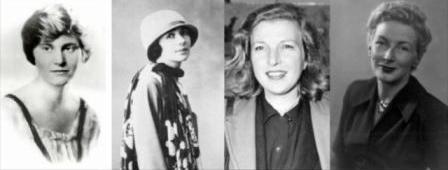
WIVES AND WOMEN: Dale Scherfling reflects on Ernest Hemingway’s life through the women who helped shape it — seeing them not as supporting characters, but as individuals
The Suitcase (Paris, December 1922)
Writers spend a lot of time worrying about the wrong things. They worry about rejection slips, editors who don’t answer letters, and whether the story they’re working on is any good. What they should worry about, apparently, is someone walking off with the suitcase.
Hadley Hemingway stepped off a train at the Gare de Lyon to buy a bottle of water. When she came back, the suitcase was gone. Inside were nearly all of Ernest Hemingway’s early manuscripts—stories, poems, notes, carbon copies. Two years of work.
He was twenty-three years old and not yet Ernest Hemingway: not the Nobel Prize winner, not the white-bearded legend, just a young writer trying to become one. The thief almost certainly had no idea what was in that bag. To him it was luggage. To Hemingway it was the closest thing he had to a future.
What makes the story remarkable is what didn’t happen. He didn’t explode. He didn’t publicly blame Hadley. He searched, found nothing, and carried on—at least outwardly. People are often calm when the wound is fresh. Sometimes the damage takes a while to arrive.
I’ve often wondered whether that loss stayed with him longer than he admitted. Not because of the pages themselves. Every writer eventually writes more pages. But every young writer secretly believes the work in front of him might be the one that changes everything. One afternoon in Paris, that possibility disappeared.
Years later he joked about it. Writers do that. Soldiers do too. Sometimes humor is simply grief wearing a borrowed hat.
Whether the lost suitcase helped shape the writer he became is impossible to prove. Life is rarely as neat as biographers would like it to be. Still, it is hard not to notice what followed. He started over. He stripped things down. He learned to trust what remained.
Maybe the missing suitcase had nothing to do with that. Or maybe one of the most important lessons of his life arrived disguised as a disaster.
Hadley never entirely stopped apologizing. I doubt Hemingway ever entirely stopped remembering.
Before Hadley
Before there was Hadley, there was Agnes.
Most first loves aren’t really first loves. They’re first wounds. Agnes von Kurowsky was a Red Cross nurse in Italy during the First World War. Hemingway was a nineteen-year-old ambulance driver with a shattered leg and a head full of plans. She was older, wiser, and eventually she chose somebody else.
Her letter was gentle enough. She told him she felt more like a mother than a sweetheart and expected to marry another man. Young Hemingway took it badly. Who wouldn’t? Friends later said the disappointment never entirely left him.
The interesting part is what he did with it. He turned it into fiction. Writers are scavengers. Nothing gets wasted.
In A Farewell to Arms, Catherine Barkley dies instead of leaving. Whether that was revenge, wish fulfillment, or simply storytelling is anyone’s guess. What interests me more is the pattern. A woman makes a choice. A man loses. Then he gets the final word on paper.
That pattern would show up again, and again. It would follow him into the next chapter of his life.
Key West
People often talk about Key West as though Hemingway deliberately chose it. The truth is messier. A missed connection here. A delayed automobile there. One temporary stay leading to another. Sometimes we arrive at important places by accident.
He stayed there, on and off, for more than a decade. Pauline Pfeiffer was his wife by then—the second wife, the woman for whom he had left Hadley. People like to simplify these things: one woman good, one woman bad. Real life is rarely that cooperative.
Pauline was smart, capable, wealthy, Catholic, and very different from Hadley. He loved her. He also carried guilt. Years later he supposedly remarked that a man should be shot for what he had done to Hadley. Then he went home and lived with Pauline. Human beings are full of contradictions.
Key West gave Hemingway something he spent much of his life pretending he didn’t need: routine. Mornings were for writing. Afternoons were for fishing. Later came drinks at Sloppy Joe’s. The heat on Whitehead Street rose in waves. The cats slept under the porch. The typewriter clattered each morning like a dependable engine.
The routine worked. The work got done. Yet even then there were signs of restlessness. There always seemed to be signs of restlessness.
The house on Whitehead Street became part of the legend, but Hemingway didn’t buy it. Pauline’s uncle, Gus Pfeiffer, paid for it. He paid for other things too—the African safari, and various rescues, large and small. By all accounts Hemingway appreciated Gus. I’ve always suspected he resented needing him. Pride is a funny thing. Most of us enjoy being helped right up until the moment we realize we needed help.
Years later, in The Snows of Kilimanjaro, he would write about a writer softened by wealth and comfort. People who knew Pauline winced. The portrait was too close to home. Reading it now, it feels less like an attack on Pauline than a man arguing with himself. Sometimes writers settle old scores. Sometimes the score they’re settling is their own.
And restlessness, once it finds its shape, rarely stays quiet.
Sloppy Joe’s
The restlessness that had begun in Key West sharpened into something more definite. Martha Gellhorn first encountered Hemingway in Sloppy Joe’s. According to her account, what she saw was a large, rumpled man sitting alone and reading his mail. Not exactly love at first sight.
She was twenty-eight, already a novelist, already a journalist, already her own person. That last part mattered.
By then Hemingway was successful, married, famous, and bored. Success creates its own problems. We spend years climbing a mountain only to discover the view isn’t enough.
Martha brought something new into the room: energy, curiosity, and a war in Spain that needed covering. She was interested in the world beyond Key West. So was he. The difference was that she intended to go. Before long he followed.
For a time Pauline showed more grace than history usually credits her with. She welcomed Martha into her home and treated her as a friend. Looking back, it feels heartbreaking. Everyone knew the story except, perhaps, the person living inside it.
By 1940 Pauline was gone. Martha was the new wife, and Hemingway had once again fallen for a woman who refused to stand still.
What Martha Would Not Be
Of all Hemingway’s wives, Martha may have been the one who least fit the role. The problem was that she never wanted the role. She wasn’t interested in being the woman behind the famous man. She had deadlines of her own, wars of her own, and stories of her own.
He admired her courage, but admiration can become complicated when it occupies the same room as pride. When D-Day arrived, Martha reached Normandy before Hemingway. The competitive side of him reportedly hated that. The journalist in me understands why. The husband in him probably hated it even more.
Their marriage didn’t survive. Neither was built for second place.
Martha spent the rest of her life refusing to be defined by the marriage, and I admire her for that. She once said she didn’t want to be a footnote in someone else’s life. History, unfortunately, has a cruel sense of humor. Even today, that sentence is usually quoted while discussing Hemingway.
Mary
Mary Welsh arrived later. By then Hemingway had survived wars, fame, divorces, acclaim, criticism, and enough adventures to fill several ordinary lives. He could be generous, funny, loyal, and astonishingly alive when the darkness wasn’t winning.
Mary became the last wife. Sometimes the last wife ends up carrying the heaviest burden. She was there for the Nobel Prize, the plane crashes, the declining health, and the growing darkness that people around him didn’t yet know how to describe. Today we would call much of it depression. Back then people mostly called it something else—or nothing at all.
After his death, Mary became the caretaker of what remained: papers, photographs, memories, and fragments of unfinished things. There is something fitting about that. The story began with missing pages in a stolen suitcase. It ended with surviving pages discovered years later in storage. Writers leave trails behind them. Sometimes others have to gather them up.
Mary once joked about the women who had been married to Hemingway, referring to them as graduates of Hemingway University. The line has always struck me as funny and sad at the same time. A marriage as an education. Heartbreak as a degree program. Some jokes contain more truth than the speaker intended.
Coda
Four wives. One nurse before them. A collection of other women history mostly leaves in the margins.
Biographers spend a great deal of time trying to identify the pattern. So do readers. Maybe the pattern is simpler than we think.
Hemingway needed rescuing from time to time. Like many proud men, he wasn’t entirely comfortable with being rescued. He needed admiration. He also needed honesty. Unfortunately, those two things rarely travel together.
The women who mattered most to him were not timid people. Hadley wasn’t. Pauline wasn’t. Martha certainly wasn’t. Mary wasn’t either. Each brought something he needed. Each eventually saw something he preferred not to see.
He lived in a time that rewarded bravado and punished doubt, and he carried both. The older I get, the less interested I am in judging any of them. Lives are complicated. Marriages are complicated. Fame complicates everything it touches.
What remains, looking back across the years, is not a villain and four victims, nor a genius surrounded by supporting characters. It is a man trying to outrun himself — and four women intelligent enough to know that no one ever really does.
The suitcase was never recovered.
Perhaps that’s fitting.
A few mysteries should stay missing.
Every writer carries one.
Aug 9 2026
Wives and Women
WIVES AND WOMEN: Dale Scherfling reflects on Ernest Hemingway’s life through the women who helped shape it — seeing them not as supporting characters, but as individuals
The Suitcase (Paris, December 1922)
Writers spend a lot of time worrying about the wrong things. They worry about rejection slips, editors who don’t answer letters, and whether the story they’re working on is any good. What they should worry about, apparently, is someone walking off with the suitcase.
Hadley Hemingway stepped off a train at the Gare de Lyon to buy a bottle of water. When she came back, the suitcase was gone. Inside were nearly all of Ernest Hemingway’s early manuscripts—stories, poems, notes, carbon copies. Two years of work.
He was twenty-three years old and not yet Ernest Hemingway: not the Nobel Prize winner, not the white-bearded legend, just a young writer trying to become one. The thief almost certainly had no idea what was in that bag. To him it was luggage. To Hemingway it was the closest thing he had to a future.
What makes the story remarkable is what didn’t happen. He didn’t explode. He didn’t publicly blame Hadley. He searched, found nothing, and carried on—at least outwardly. People are often calm when the wound is fresh. Sometimes the damage takes a while to arrive.
I’ve often wondered whether that loss stayed with him longer than he admitted. Not because of the pages themselves. Every writer eventually writes more pages. But every young writer secretly believes the work in front of him might be the one that changes everything. One afternoon in Paris, that possibility disappeared.
Years later he joked about it. Writers do that. Soldiers do too. Sometimes humor is simply grief wearing a borrowed hat.
Whether the lost suitcase helped shape the writer he became is impossible to prove. Life is rarely as neat as biographers would like it to be. Still, it is hard not to notice what followed. He started over. He stripped things down. He learned to trust what remained.
Maybe the missing suitcase had nothing to do with that. Or maybe one of the most important lessons of his life arrived disguised as a disaster.
Hadley never entirely stopped apologizing. I doubt Hemingway ever entirely stopped remembering.
Before Hadley
Before there was Hadley, there was Agnes.
Most first loves aren’t really first loves. They’re first wounds. Agnes von Kurowsky was a Red Cross nurse in Italy during the First World War. Hemingway was a nineteen-year-old ambulance driver with a shattered leg and a head full of plans. She was older, wiser, and eventually she chose somebody else.
Her letter was gentle enough. She told him she felt more like a mother than a sweetheart and expected to marry another man. Young Hemingway took it badly. Who wouldn’t? Friends later said the disappointment never entirely left him.
The interesting part is what he did with it. He turned it into fiction. Writers are scavengers. Nothing gets wasted.
In A Farewell to Arms, Catherine Barkley dies instead of leaving. Whether that was revenge, wish fulfillment, or simply storytelling is anyone’s guess. What interests me more is the pattern. A woman makes a choice. A man loses. Then he gets the final word on paper.
That pattern would show up again, and again. It would follow him into the next chapter of his life.
Key West
People often talk about Key West as though Hemingway deliberately chose it. The truth is messier. A missed connection here. A delayed automobile there. One temporary stay leading to another. Sometimes we arrive at important places by accident.
He stayed there, on and off, for more than a decade. Pauline Pfeiffer was his wife by then—the second wife, the woman for whom he had left Hadley. People like to simplify these things: one woman good, one woman bad. Real life is rarely that cooperative.
Pauline was smart, capable, wealthy, Catholic, and very different from Hadley. He loved her. He also carried guilt. Years later he supposedly remarked that a man should be shot for what he had done to Hadley. Then he went home and lived with Pauline. Human beings are full of contradictions.
Key West gave Hemingway something he spent much of his life pretending he didn’t need: routine. Mornings were for writing. Afternoons were for fishing. Later came drinks at Sloppy Joe’s. The heat on Whitehead Street rose in waves. The cats slept under the porch. The typewriter clattered each morning like a dependable engine.
The routine worked. The work got done. Yet even then there were signs of restlessness. There always seemed to be signs of restlessness.
The house on Whitehead Street became part of the legend, but Hemingway didn’t buy it. Pauline’s uncle, Gus Pfeiffer, paid for it. He paid for other things too—the African safari, and various rescues, large and small. By all accounts Hemingway appreciated Gus. I’ve always suspected he resented needing him. Pride is a funny thing. Most of us enjoy being helped right up until the moment we realize we needed help.
Years later, in The Snows of Kilimanjaro, he would write about a writer softened by wealth and comfort. People who knew Pauline winced. The portrait was too close to home. Reading it now, it feels less like an attack on Pauline than a man arguing with himself. Sometimes writers settle old scores. Sometimes the score they’re settling is their own.
And restlessness, once it finds its shape, rarely stays quiet.
Sloppy Joe’s
The restlessness that had begun in Key West sharpened into something more definite. Martha Gellhorn first encountered Hemingway in Sloppy Joe’s. According to her account, what she saw was a large, rumpled man sitting alone and reading his mail. Not exactly love at first sight.
She was twenty-eight, already a novelist, already a journalist, already her own person. That last part mattered.
By then Hemingway was successful, married, famous, and bored. Success creates its own problems. We spend years climbing a mountain only to discover the view isn’t enough.
Martha brought something new into the room: energy, curiosity, and a war in Spain that needed covering. She was interested in the world beyond Key West. So was he. The difference was that she intended to go. Before long he followed.
For a time Pauline showed more grace than history usually credits her with. She welcomed Martha into her home and treated her as a friend. Looking back, it feels heartbreaking. Everyone knew the story except, perhaps, the person living inside it.
By 1940 Pauline was gone. Martha was the new wife, and Hemingway had once again fallen for a woman who refused to stand still.
What Martha Would Not Be
Of all Hemingway’s wives, Martha may have been the one who least fit the role. The problem was that she never wanted the role. She wasn’t interested in being the woman behind the famous man. She had deadlines of her own, wars of her own, and stories of her own.
He admired her courage, but admiration can become complicated when it occupies the same room as pride. When D-Day arrived, Martha reached Normandy before Hemingway. The competitive side of him reportedly hated that. The journalist in me understands why. The husband in him probably hated it even more.
Their marriage didn’t survive. Neither was built for second place.
Martha spent the rest of her life refusing to be defined by the marriage, and I admire her for that. She once said she didn’t want to be a footnote in someone else’s life. History, unfortunately, has a cruel sense of humor. Even today, that sentence is usually quoted while discussing Hemingway.
Mary
Mary Welsh arrived later. By then Hemingway had survived wars, fame, divorces, acclaim, criticism, and enough adventures to fill several ordinary lives. He could be generous, funny, loyal, and astonishingly alive when the darkness wasn’t winning.
Mary became the last wife. Sometimes the last wife ends up carrying the heaviest burden. She was there for the Nobel Prize, the plane crashes, the declining health, and the growing darkness that people around him didn’t yet know how to describe. Today we would call much of it depression. Back then people mostly called it something else—or nothing at all.
After his death, Mary became the caretaker of what remained: papers, photographs, memories, and fragments of unfinished things. There is something fitting about that. The story began with missing pages in a stolen suitcase. It ended with surviving pages discovered years later in storage. Writers leave trails behind them. Sometimes others have to gather them up.
Mary once joked about the women who had been married to Hemingway, referring to them as graduates of Hemingway University. The line has always struck me as funny and sad at the same time. A marriage as an education. Heartbreak as a degree program. Some jokes contain more truth than the speaker intended.
Coda
Four wives. One nurse before them. A collection of other women history mostly leaves in the margins.
Biographers spend a great deal of time trying to identify the pattern. So do readers. Maybe the pattern is simpler than we think.
Hemingway needed rescuing from time to time. Like many proud men, he wasn’t entirely comfortable with being rescued. He needed admiration. He also needed honesty. Unfortunately, those two things rarely travel together.
The women who mattered most to him were not timid people. Hadley wasn’t. Pauline wasn’t. Martha certainly wasn’t. Mary wasn’t either. Each brought something he needed. Each eventually saw something he preferred not to see.
He lived in a time that rewarded bravado and punished doubt, and he carried both. The older I get, the less interested I am in judging any of them. Lives are complicated. Marriages are complicated. Fame complicates everything it touches.
What remains, looking back across the years, is not a villain and four victims, nor a genius surrounded by supporting characters. It is a man trying to outrun himself — and four women intelligent enough to know that no one ever really does.
The suitcase was never recovered.
Perhaps that’s fitting.
A few mysteries should stay missing.
Every writer carries one.