.
Poetry review – LILITH SPEAKS: Pam Thompson admires a short collection by Clare Proctor which manages to shift through many situations
 Lilith Speaks
Clare Proctor
Wayleave Press
ISBN 9 781-0685762-1-8
21pp. £7
Lilith Speaks
Clare Proctor
Wayleave Press
ISBN 9 781-0685762-1-8
21pp.    £7
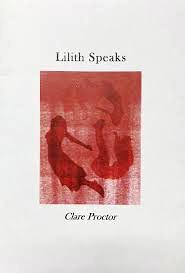
Clare Proctor is a member of the Brewery Poets who are based in the Brewery Arts Centre in Kendal. This beautifully produced pamphlet was selected for publication from the 2024 Litfest/Wayleave Pamphlet Competition. Zoë Kingston’s cover image catches the eye with its three red female figures in the act of floating, tumbling or falling.
In Hebrew mythology Lilith is demonic and transgressive and the spirit of female transgression permeates the poems. Lilith appears here in many guises, from the ancient and archetypal to the more personal and contemporary. Narrative is handled fluidly and persuasively. Rhythms are sure and the range of forms varied.
The opening poem, “Shhh” sets out how society has silenced girls and made them suppress their desires, ‘Girls aren’t to speak of this’. The rest of the pamphlet is a rejoinder to imposed silences. Lilith is manifest in each poem in a spirit of female defiance or transgression, or in the glimpse that all is not right and that there is a bigger world and greater freedoms beyond a relationship. This is particularly apparent in “Lilith Speaks”, a poem derived from Malleus Maleficarum, a 15th century witch hunting manual, in which its author writes of witches who reputedly collected male organs:
We keep them as pets,
tied at one end
to stop the innards falling out….

Sometimes we fight
to hold our favourites
feel them fattening
between our hands.
It is both humorous and grotesque. The last three lines are somewhat mysterious. Who is the addressee? Is this a dig at some men pretending to be ‘bigger’, in all senses, than they actually are?
You want yours back
But you never make the right choice,
You never claim your own.
Too often a woman is a muse for a male artist; decorative, almost an accessory. In “The Woman Wears a Green Dress”, after a painting by Julian Cooper, we get the impression of an incidental figure standing in a bar. She is unnamed and denoted by her clothing and her anonymity, ‘The woman is the body that makes a shadow’ yet as the poem continues we sense that her senses are alert and attuned to the freedom of the outside, ‘listening to the wind / crossing a far-off ocean. / Her green dress lifts in it.’ This pull from entrapment towards release is a keynote here and elsewhere.
If the pamphlet begins with a tiny poem, taking up a small space, like the girls inside it, “Sappho’s Leap” commands the space on two pages It draws on “The Last Song of Sappho”’ by Felicia Hemans and is a haunting prose poem in six sections, speaking of women who leap from cliffs. Its repetitions produce its own tides, each section beginning with the phrase, ‘The women …’ or a variation. The first section sets out the awful dilemma:
The women are ceaseless. The women are ceaseless as the waves. The women are
ceaseless as their own echoing sighs. The only way for the women to be still as the
sea-bird hovering on the death wind, is for the women to throw themselves from cliffs.
Of course, women cannot just leap from cliffs in male-constructed versions: it must be done decorously. For the ‘man/sea god’, ‘ they should dive in a perfect arc … The woman’s pain should be private … They should avoid ugly crying …should check the tides’. They should never land on the rocks, their bodies should be in one piece, in all, their beauty should be preserved for whatever use the man/sea god wants, to paint or idealise in another way.
In “Bear Hug”, a man’s hug of alleged protectiveness becomes oppressive and controlling. The poem outlines the passage of the woman’s growing wariness, ‘In you come. She thinks perhaps …’ and eventual entrapment, of the loss of wildness and autonomy, ‘She forgets the feeling of wood under her fingers, / the tearing of bark for tinder/ head muffled by his chest, /she now sees only snippets -/pine against white sky.’
Next to this poem and related in context is “Seal Woman”, another woman whose agency has been stolen by the adoption of conventional roles. She is ‘selkie’, the seal woman of mythology, some of whom, as here, marry humans and become unhappy. It is a short poem but an effective one in its attention to time: the past in her dreams where ‘her body remembers / the pitch and heave of water’; the present in those conventional roles where, ‘Her skin cracks upon a hanger / behind a locked door’, and the future, of freedom, symbolised by ‘an absence that will leave / keys dangling’, her husband leaving the house. Her fine senses gauge the moment.
The subject-matter of “Hunter” is particularly grim: the hunter kills a female, animal or human (we don’t know whuch) letting her skin dry to reveal the bones; yet its use of language, sonic effects and pacing is precise and elegant, rendering the act chillingly sacrificial and elevating it to song:
yet how light her disrobed bones were,
how they brittled and sang,
made of him a minstrel.
Another anonymous women features in “The Next Wife” whose job it is to sweep up the detritus of former wives whose language has become ‘beads’ which gather in corners as fast as she tries to clean them up.
Transformation is a common theme in myths and folk tales where a woman become an animal, bird or plant, say, to escape male cruelty. That the next wife ‘is a pane of glass’ is an unusual take on this, a means of self-effacement but of personal transcendence, ‘he will see how the light / shines right through her.’ Windows feature in the two poems which follow. “Last Night” and “Break in” seem to be connected. The former has a sinister heaviness, ‘Last night the darkness dripped through the window … became a seal’s eye … hardened’. No woman is present but a polar bear ‘tasting the sense of body’ tries to intrude. “Break in” is a list poem, a litany, which reminded me of Clare Shaw. The first half of each sentence, ‘when I open the window’, is repeated and the tension builds as the speaker faces an intruder, ‘he’s waiting for me … his name is a claw … his hands grow wings … my body’s a lock’. It’s a series of non-sequitors which have a disorienting nightmarish effect as though a kind of static struggle is going on. The last line could be construed as submission, ‘when I open the window, I’m ready, I’m waiting’, but in this context, is more like defiance.
“Demon”, (After Edwin Morgan), is lavish and dark as we meet Lilith as Demon, or possessed by the Demon or both at once. I discovered that Edwin Morgan has a pamphlet called Demon (Mariscat Press) so perhaps Claire Proctor’s poem takes its flavour from that pamphlet. “Demon”, with its long lines, hypnotic alternating repetitions of ‘you’ and ‘I’ and dramatic imagery has a wonderful performative feel:
You turned me inside out. The streets were thick, the shadows had eyes
and all of them were the same. You asked me to stay with you
and I said Yes. Your howl was a bridge.
Your howl could bear the weight of us
if we chose to cross it from this world to the next.
“87 Thanington Road” is a very specific address. Images from previous poems reappear: locks, windows, claw-like hands. It’s a sestina which is driven so successfully by narrative that the repeated end-words are folded in unobstrusively. Like others, it moves towards entrapment to some kind of escape. There are some compelling and suggestive lines, ‘his lies … how river-easy they ran … It has taken me all this time to climb / out of the body he branded … lies transformed, weightless as blossom, falling from my hands.’ It could be a confessional poem where the form lifts it from being just a personal narrative.
The final few poems more obviously circulate around the poet’s own life and family. Lilith is here, close to the earth, being repeated in domestic activities. In “To Weed” we sense that the act of tending the garden allows the woman to contemplate the intersection between action and inaction; to be both steadied and agitated, biding one’s time. Repeated phrases once more let us understand this; a kind of displaced human commentary:
To make a decision. To unwind time. To understand that mark-
making is temporary. To know that you can never reach deep enough. To
understand that the job is never finished.

To leave your mind at the door. To be at peace. To follow in your
mother’s footsteps.
Following this, and connected, is “Evening garden”, a moving ghazal, whose form suitably returns the memory of the poet’s mother in her garden to the evening where the poet works in her own:
My mother’s the roots of all plants that I grow
and as ever, my heart’s constant guide, tonight.
In “Animal instinct” Lilith surfaces as female desire, as a rush to reproduce, ‘Time is running out … I am not in control of this’. “On Absence”, a stand-out prose poem elucidates the unease which underpins the pamphlet in reflecting on the word ‘absence’, beginning in a classroom with a teacher taking the register, the absence of a child in the class, of a child for the teacher, whether it is tangible or not, ‘A glove without a hand on a fence post. A shoe without a foot next too a motorway. A travel cot in a box in a wardrobe’. I felt that I’d travelled outwards but was then pulled back again, still searching.
Clare Proctor is expert at shifting and in overlaying what should be light-hearted (e.g. a children’s game) with darkness. Take “Ready or not”, which I quote in full:
My father lost his mother piece by piece.
First one breast. Then the other. Arm next.
He wondered where she hid them, searched
under her bed for lumps
of skin; scattered the dust,
feeling for a pulse.
Here I come, he
Bellowed out
to no one.
“Bones” is a strange poem of celebration making us hold in mind a whole range of active human activity but, as the focus is on bones doing all this, decay and death is ever-present. The poem moves through a human life span from birth to death, ending once more, with memory, ‘bones never to be forgotten, bones that I love, to / their very bones.’
In the final poem, “The End of that Year”, the poet remembers a specific time, place and person (mother?),
Seven o’ clock. Time muffles
the sounds I can’t remember so make up,
like the bark of a dog as your car pulls in,
or the pouring of a gin and French
in time for the Archers.
And why wouldn’t we make up details to colour in a memory? I love the specifics here, ‘ the kitchen table marked with lead spots, / playdough in the grain.’ I love the final three lines in particular but I’ll keep those a secret. There are no demons as such at the end but I think Claire Proctor wants us to recognise in this fine pamphlet that Lilith will always be present in the women who persist and endure.
Jan 19 2026
London Grip Poetry Review – Clare Proctor
.
Poetry review – LILITH SPEAKS: Pam Thompson admires a short collection by Clare Proctor which manages to shift through many situations
Clare Proctor is a member of the Brewery Poets who are based in the Brewery Arts Centre in Kendal. This beautifully produced pamphlet was selected for publication from the 2024 Litfest/Wayleave Pamphlet Competition. Zoë Kingston’s cover image catches the eye with its three red female figures in the act of floating, tumbling or falling.
In Hebrew mythology Lilith is demonic and transgressive and the spirit of female transgression permeates the poems. Lilith appears here in many guises, from the ancient and archetypal to the more personal and contemporary. Narrative is handled fluidly and persuasively. Rhythms are sure and the range of forms varied.
The opening poem, “Shhh” sets out how society has silenced girls and made them suppress their desires, ‘Girls aren’t to speak of this’. The rest of the pamphlet is a rejoinder to imposed silences. Lilith is manifest in each poem in a spirit of female defiance or transgression, or in the glimpse that all is not right and that there is a bigger world and greater freedoms beyond a relationship. This is particularly apparent in “Lilith Speaks”, a poem derived from Malleus Maleficarum, a 15th century witch hunting manual, in which its author writes of witches who reputedly collected male organs:
It is both humorous and grotesque. The last three lines are somewhat mysterious. Who is the addressee? Is this a dig at some men pretending to be ‘bigger’, in all senses, than they actually are?
Too often a woman is a muse for a male artist; decorative, almost an accessory. In “The Woman Wears a Green Dress”, after a painting by Julian Cooper, we get the impression of an incidental figure standing in a bar. She is unnamed and denoted by her clothing and her anonymity, ‘The woman is the body that makes a shadow’ yet as the poem continues we sense that her senses are alert and attuned to the freedom of the outside, ‘listening to the wind / crossing a far-off ocean. / Her green dress lifts in it.’ This pull from entrapment towards release is a keynote here and elsewhere.
If the pamphlet begins with a tiny poem, taking up a small space, like the girls inside it, “Sappho’s Leap” commands the space on two pages It draws on “The Last Song of Sappho”’ by Felicia Hemans and is a haunting prose poem in six sections, speaking of women who leap from cliffs. Its repetitions produce its own tides, each section beginning with the phrase, ‘The women …’ or a variation. The first section sets out the awful dilemma:
Of course, women cannot just leap from cliffs in male-constructed versions: it must be done decorously. For the ‘man/sea god’, ‘ they should dive in a perfect arc … The woman’s pain should be private … They should avoid ugly crying …should check the tides’. They should never land on the rocks, their bodies should be in one piece, in all, their beauty should be preserved for whatever use the man/sea god wants, to paint or idealise in another way.
In “Bear Hug”, a man’s hug of alleged protectiveness becomes oppressive and controlling. The poem outlines the passage of the woman’s growing wariness, ‘In you come. She thinks perhaps …’ and eventual entrapment, of the loss of wildness and autonomy, ‘She forgets the feeling of wood under her fingers, / the tearing of bark for tinder/ head muffled by his chest, /she now sees only snippets -/pine against white sky.’
Next to this poem and related in context is “Seal Woman”, another woman whose agency has been stolen by the adoption of conventional roles. She is ‘selkie’, the seal woman of mythology, some of whom, as here, marry humans and become unhappy. It is a short poem but an effective one in its attention to time: the past in her dreams where ‘her body remembers / the pitch and heave of water’; the present in those conventional roles where, ‘Her skin cracks upon a hanger / behind a locked door’, and the future, of freedom, symbolised by ‘an absence that will leave / keys dangling’, her husband leaving the house. Her fine senses gauge the moment.
The subject-matter of “Hunter” is particularly grim: the hunter kills a female, animal or human (we don’t know whuch) letting her skin dry to reveal the bones; yet its use of language, sonic effects and pacing is precise and elegant, rendering the act chillingly sacrificial and elevating it to song:
Another anonymous women features in “The Next Wife” whose job it is to sweep up the detritus of former wives whose language has become ‘beads’ which gather in corners as fast as she tries to clean them up.
Transformation is a common theme in myths and folk tales where a woman become an animal, bird or plant, say, to escape male cruelty. That the next wife ‘is a pane of glass’ is an unusual take on this, a means of self-effacement but of personal transcendence, ‘he will see how the light / shines right through her.’ Windows feature in the two poems which follow. “Last Night” and “Break in” seem to be connected. The former has a sinister heaviness, ‘Last night the darkness dripped through the window … became a seal’s eye … hardened’. No woman is present but a polar bear ‘tasting the sense of body’ tries to intrude. “Break in” is a list poem, a litany, which reminded me of Clare Shaw. The first half of each sentence, ‘when I open the window’, is repeated and the tension builds as the speaker faces an intruder, ‘he’s waiting for me … his name is a claw … his hands grow wings … my body’s a lock’. It’s a series of non-sequitors which have a disorienting nightmarish effect as though a kind of static struggle is going on. The last line could be construed as submission, ‘when I open the window, I’m ready, I’m waiting’, but in this context, is more like defiance.
“Demon”, (After Edwin Morgan), is lavish and dark as we meet Lilith as Demon, or possessed by the Demon or both at once. I discovered that Edwin Morgan has a pamphlet called Demon (Mariscat Press) so perhaps Claire Proctor’s poem takes its flavour from that pamphlet. “Demon”, with its long lines, hypnotic alternating repetitions of ‘you’ and ‘I’ and dramatic imagery has a wonderful performative feel:
“87 Thanington Road” is a very specific address. Images from previous poems reappear: locks, windows, claw-like hands. It’s a sestina which is driven so successfully by narrative that the repeated end-words are folded in unobstrusively. Like others, it moves towards entrapment to some kind of escape. There are some compelling and suggestive lines, ‘his lies … how river-easy they ran … It has taken me all this time to climb / out of the body he branded … lies transformed, weightless as blossom, falling from my hands.’ It could be a confessional poem where the form lifts it from being just a personal narrative.
The final few poems more obviously circulate around the poet’s own life and family. Lilith is here, close to the earth, being repeated in domestic activities. In “To Weed” we sense that the act of tending the garden allows the woman to contemplate the intersection between action and inaction; to be both steadied and agitated, biding one’s time. Repeated phrases once more let us understand this; a kind of displaced human commentary:
Following this, and connected, is “Evening garden”, a moving ghazal, whose form suitably returns the memory of the poet’s mother in her garden to the evening where the poet works in her own:
In “Animal instinct” Lilith surfaces as female desire, as a rush to reproduce, ‘Time is running out … I am not in control of this’. “On Absence”, a stand-out prose poem elucidates the unease which underpins the pamphlet in reflecting on the word ‘absence’, beginning in a classroom with a teacher taking the register, the absence of a child in the class, of a child for the teacher, whether it is tangible or not, ‘A glove without a hand on a fence post. A shoe without a foot next too a motorway. A travel cot in a box in a wardrobe’. I felt that I’d travelled outwards but was then pulled back again, still searching.
Clare Proctor is expert at shifting and in overlaying what should be light-hearted (e.g. a children’s game) with darkness. Take “Ready or not”, which I quote in full:
“Bones” is a strange poem of celebration making us hold in mind a whole range of active human activity but, as the focus is on bones doing all this, decay and death is ever-present. The poem moves through a human life span from birth to death, ending once more, with memory, ‘bones never to be forgotten, bones that I love, to / their very bones.’
In the final poem, “The End of that Year”, the poet remembers a specific time, place and person (mother?),
And why wouldn’t we make up details to colour in a memory? I love the specifics here, ‘ the kitchen table marked with lead spots, / playdough in the grain.’ I love the final three lines in particular but I’ll keep those a secret. There are no demons as such at the end but I think Claire Proctor wants us to recognise in this fine pamphlet that Lilith will always be present in the women who persist and endure.