Feb 3 2026
London Grip Poetry Review – Diane Sahms
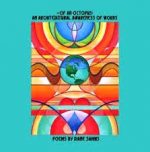
Poetry review –of an octopus: an archite|x|tural awareness of words: Charles Rammelkamp reviews an intriguing new collection by Diane Sahms
“–of an octopus: an archite|x|tural awareness of words”
Diane Sahms
Carbonation Press, 2026
$20.00, 130 pages
ISBN: 978-1-105-91128-6
Diane Sahms has always channeled other artistic expressions in her poetry. In Blues, Prayers and Pagan Chants, for instance, music and voice inform her verse. In her new collection, it’s shapes, colors, and words themselves. Instead of Leon Russell and Lord Byron, her muses include Ludwig Wittgenstein, the American painter and illustrator N.C. Wyeth, Tomas Tranströmer, and Vincente Huidobro, among others. Indeed, the pieces in –of an octopus: an archite|x|tural awareness of words must be seen in order to appreciate their meaning, as Sahms plays with visual imagery, color and shape in this truly experimental project. Some pieces, like “—of a Still life,” “—of primitive lives,” and “—of the eye in the Sky” contain visual puns, such as the Goodyear Blimp. Two pieces, “—of La Bohémienne endormie” and “—of jungle jungle-ling,” employ the paintings of Henri Rousseau to make their statements, without exactly being ekphrastic works.
In her introduction to the collection, Sahms explains her inspiration. Two epigraphs by the poet Wallace Stevens – “All poetry is experimental poetry” – and the painter Paul Klee – “Color is the place where our brain and universe meet” – illuminate her thoughts. Indeed, typography, the shapes and arrangements of the words on the page, and color are both important to Sahms. Poems like “—of Pinkish | Red” (imagine those words are colored pinkish red, as they are in the book) and “—of an OAK” rely on the colors of the letters, as do others in the book, such as “—of L-O-V-E, as letters” (imagine L-O-V-E in red) and “—of a blue doll’s transparency on earth, part 1” and “—of a blue doll’s transparency on earth, part 2”, which both employ the color blue. “L-A-N-G-U-A-G-E Game,” which she calls a humorous word game in her introduction, also uses colored letters. The reader participates in the poet’s playfulness. It reminds me of William Faulkner’s wish to have the various voices of The Sound and the Fury printed in different colors to serve his narrative purpose (eventually, a 2012 folio edition over eighty years after the original publication of Faulkner’s novel used fourteen different colors).
–of an octopus: an archite|x|tural awareness of words is divided into six different parts. The final one, Kaleidoscopic Thoughts, includes a section called WORD ART, which is a set of five different experimental poems that employ color and typography. There is “Rainbow,” with red, orange, yellow, green, blue, indigo and violet “rainbow” word arrangements, “Bone Flowers,” “Rectangle of Rain,” “HO(O)UR-GLASS,” and “LIFE.” Here is an attempt at re-creating the visual appearance of the fourth, “HO(O)UR-GLASS,” just to give a sense of what Sahms is up to, visually:
“HO(O)UR-GLASS,”
H O
(O) U
R
G
L A
S__ S
no time;
our ass is on the line
LIFE is a picture poem with two calendar pages, one labeled BIRTH DAY, with the numbers 1 through 31, highlighted in yellow backgrounds, and an identical page (both with 5 X 7 rectangles) labeled DEATH DAY, with black lines like bar graphs in the rectangles in place of the numbers. Death appears to be something like an erasure, a blotting out. This is interesting considering the epigraph to section 4, “Deadly | Crossing” from Toni Morrison’s 1993 Nobel Prize Acceptance Speech. Morrison writes:
“We die. That may be the meaning of life.
But we do language. This may be the measure of our lives.”
Which brings us back to the section called “L-A-N-G-U-A-G-E Game” (note: the L and the N are red in the text). It’s prefaced by an epigraph from the logician Ludwig Wittgenstein: “A doubt about existence only works in a language game.” Suffice it to say that Sahms cleverly teases out “GUAGE” and “PLAGUE” and even “YAY! HOORAY!” from the word, It ends: “This is the End: at the End of the linE.” Language is a game, isn’t it? In the “Reflections | Images” section, words are skewed on the page in 45-degree angles
“—of Scorpius,” from the first section, may be the perfect example of what Sahms is attempting to capture with her visual arrangements of words. Scorpius is the ancient zodiac constellation that we recognize in the night sky by its J shape and the brilliant red star Antares (“the heart of the scorpion”). The poem starts out:
Clearest dark night.
Connect-the-dots / stars.
Big Dipper scoops me up.
Orion undresses, lays huis studded
diamond belt at my feet,
drops stringed bow / directs me to
And then we’re treated to Sahms’ visual recreation of stars and ultimately:
S
S U
C
O I
R P
As the poem goes on, “aqua-greenish” appears in blue-green type and “fuchsia red” in red type, as she describes the ‘neon light of survival / to illuminate darkness from pincers / to anus’s curled tail.’
This dreamy night, eyes possess
night vision & Scorpius immerses
me in feminine glow to throw off
predators. Body’s giant light
receptors incr4ease my protective
appearance, by a thousand times.
–of an octopus: an archite|x|tural awareness of words is an intriguing project by a seasoned poet, suggesting just how far poetry can be stretched, in Sahms’ own concluding words in her introduction, ‘in an ever-evolving interpretation of what Poetry Is.’
New Review at London Grip | Diane Sahms
03/02/2026 @ 21:45
[…] https://londongrip.co.uk/2026/02/london-grip-poetry-review-diane-sahms/ . . […]