Poetry review – ETHNOLOGY
Ian Pople explores the complexities of Cathy Galvin’s poems about people and place
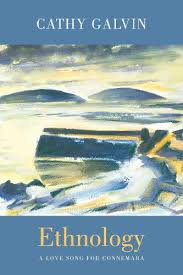 Ethnology: A love song for Connemara
Cathy Galvin
Bloodaxe Books
ISBN 9781780377728
£12.99
The full title of Cathy Galvin’s first full collection combines two distinct elements. One is a seemingly rigorous procedure, ‘ethnology’, which is defined by the OED as ‘the branch of knowledge that deals with the characteristics of different peoples and the differences and relationships between them;’ and the other is the ‘love song,’ with all its emotional depth. The latter puts the writer in the place of a singer. And singing is an important reference point in many of the poems in this distinguished book. That sense of a combination of approaches is also part of the documentation of Ethnology as it contains photographs of Galvin’s Irish family as well as various found texts, including maps, that offer testimony to the ways in which Connemara has been documented in previous epochs.
The cast also includes other figures and their words, including the 19th century anthropologist, Charles R. Browne, the textile designer, Enid Hooper, the poet Michael Hartnett, and even the philosopher, Wittgenstein, who, Galvin tells us, lived in a bungalow beside a Connemara harbour in the 1940s. The final result is a rich book, that might well have felt a little over-stuffed and overwrought were it not for Galvin’s skill as a storyteller. In part, we might put this down to her experience as a journalist telling complex stories clearly and calmly. But part of Galvin’s ability is a profoundly empathetic adeptness at choosing which of these many facets of her family’s relationship to Connemara to pull out.
That ability to select and focus is supported by the style and voice that emerges over these pages. As I have noted, Galvin has worked as a journalist for such organs as Newsweek and The Sunday Times. However, the style of her voice is not plain; Galvin’s poetry is never what we might call ‘journalese.’ But she knows exactly how to weigh the language; there are few adjectives and adverbs. The music emerges from the way the sentences work and fall; their messages delivered with precision, the cadences measured and adroit.
In the introduction to the book, Galvin comments that the love song ‘is sung into the shell of an island cottage built by my great-grandfather for his family after the Great Famine.’ This is a cottage on an island that Galvin now has a claim to; the title deed of which is presented as a preface. Ethnology is divided up into four ‘books’, the first titled ‘Specimens,’ the second ‘Mother,’ the third ‘Love Songs of Connacht’ and the final, fourth book titled, ‘Son.’
‘Book One: Specimens,’ begins with a statement from the anthropologist, Charles R. Browne, introducing an ‘anthropometric’ report carried out on ‘thirty-eight men, who, …, from the fixity of type prevailing in this as the most western districts, were fairly representative specimens.’ This is followed by a group of four poems in which Galvin imagines the legacy of that place in her own life. For example, ‘The road becomes smaller, / heading into my veins.’ (‘Island Road’) or ‘Inward, rowing in, I come as a thief / to steal your life, like a collector. / Outward, rowing out, your gift to me is scented’ (‘Blunt Needles’). In the third poem of that group she speaks of ‘A rope of narrative, an umbilical cord of love.’ As we can see here, Galvin is highly conscious of her position as both insider and outsider. Galvin’s biography positions her as an outsider but, as she tells us in her introduction as well, her mother and grand-parents spoke Irish around her in her childhood. And her grandparents ferried her to that island, Mason Island, in a currach.
Perhaps it is that tension between the inner and outer connections that gives rise to much in the poems that we might call vatic. This is an attempt to give voice to both mystery of those connections and the energy that tension creates. ‘Women Come to Find Me’ begins
A small spoil-heap,
a sigh of the sí
a staring chestnut face,
gone in flight across stone and gorse,
then one, two, three hares
cross my path on the way to the quay.
My women, come to greet me;
prayers answered from the time of loss
to the time of plenty.
Galvin glosses ‘sí’ as ‘a “fairy”, magical place. However, the opening cataloguing of the spoil-heap, the sí, rather strange chestnut face, and then the three hares, elides explicit connections but each item seems to radiate significance. This is not only clear in the mention of the sí, but the three hares is a clear reference to the depiction of three hares in a circle, which is a mystical symbol, perhaps of fertility, found across cultures from China to Europe. And these hares cross the narrator’s path. That mysticism is then moved into the women, ‘my’ women we note, who come to greet the narrator in answer to prayers. ‘Women Come to Find Me’ with that further tension around the word ‘Come’ is it a simple action or an order, ends,
I am here to learn,
if they will let me.
The poem has moved from that inner intensity to a final admission of outsider-hood, ‘if they will let me.’
As already noted, Ethnology is divided into four ‘books’, the second of which is entitled ‘Mother.’ This section begins with a moving epigraph from J.M. Synge’s book on the Aran Island. The epigraph describes the disinterring of a skull, and the actions of an ‘old woman’ at that moment. The epigraph finishes, ‘Then she sat down and put [the skull] in her lap – it was the skull of her mother – and began keening over it with the wildest lamentations.’ The poems that follow are a stingingly intense investigation of the ties between mother and daughter. In particular, the poems describe the ways in which mother and daughter are bound together both in childbirth and in the laying to rest. The connections between the two are explored with skill in the opening two stanzas of the opening poem in this section, ‘Waters Break.’ The poem begins with an almost apocalyptic description of a hurricane’s effect upon an island shore which seems to act as a metaphor for childbirth. Then the poem moves into a ward in a city hospital,
You are alone in a tower wreathed in cigarette smoke
where the city washes below:
I am away, getting it wrong,
Not hearing the doctors’ footsteps, not seeing what they cut from you
and throw to the pail.
Via ‘Hail Marys’ and comments of ‘a ghrá mo chroí,’ that Galvin footnotes as a ‘familiar endearment meaning “my love”,’ the poem returns to a vision of death as a re-entering of the waters around the island of her mother’s birth.
The rest of this second ‘book’ in Ethnology explores the intense centrifugal/centripetal pull of the mother/daughter dynamic. That dynamic is shown in the words of ‘What They Say to a Child,’ of which these are the sixth, seventh and eighth lines,
Stop slouching She didn’t want you to wear glasses and not be pretty.
Stop biting your nails She would never have stayed married to your father.
Skulking behind like an orphan She was the peacemaker.
Here we see ‘what they say to a child,’ when the child is young and then much older. On the left, the kind of negativity that parents impose on the child. On the right, the third person ‘she,’ offers a kind of explanation which only offers a sanitised emotional history; the one kind of language eliding and missing the other. Here, Galvin, as poet/journalist, shows that, however intense the feeling between mother and child, that intensity can be buried under ideas of the social conventions, the socially and linguistically conditioned expectations of that relationship.
That sense of the language of a place both conditioning the place and being conditioned in the place are further explored in the third ‘book,’ ‘Love Songs of Connacht.’ In this section, we meet Douglas Hyde, future President of Ireland, whose own ‘Love Songs of Connacht’ collected poems from Connacht in Irish and English in the nineteenth century. Also featured are the poets Richard Murphy, Ted Hughes, Tim Robinson, the writer whose Connemara: A Little Gaelic Kingdom is a classic of the ethnology that Galvin explores, and many others. Again, Galvin’s writing is often in dialogue with those others. In ‘The Singer’s Centenary: Carna,’ for example, Galvin quotes a letter to her from the poet Glyn Hughes, Hughes’ prosaic lines alternating with Galvin’s description of the singing of Joe Heaney. Hughes tussles with the idea that his ex-wife had had an affair with the singer. Galvin depicts the singer performing ‘lyrics with the harp of water, whistle of bird, … and hidden rebellion, a sea of wrecks.’ Here, again, Galvin shows how language reaches deep into the personal; how we can be swept up into performance; the consuming performance of the singer and the performance of the man remembering a betrayal that late in the letter he realises that he might well have got wrong after all.
The final book is ‘Son,’ in which Galvin exercises her maternal keening for her son, Connor. The central sequence is simply entitled, ‘After,’ and, as you might imagine, shows the poet in the aftermath of the death of her son. This is a deeply poignant rendering in which language, too, shows its inadequacies and yet, that is the resource the poet has, ‘All that lies within / the language I cannot speak. / There is new life. There is growing old. Tell me, if you know, how to live, to love, to return.’ The sequence, ‘After’ is bracketed by two short lyrics that place Galvin’s mourning in slightly different contexts. The first poem is ‘Samhain,’ being November, the Celtic month of the dead. It begins, ‘Cailleach stands / on one foot / one eye closed / to watch her sea-god / betrayer Manannán / who took her skin // as a bag to carry / his treasure.’ At the end of the section, Galvin ventriloquises Grace O’Malley, ‘16th-century noblewoman and dynastic leader.’ O’Malley sends her own son to fight the English, ‘the child, grown on granite and grass, /steps aboard. Our men fill the hold, / lower the sails, steady the oars. / My guns are ready.’
The death of the child is like a skinning, in which the skin becomes a container for what is taken. And yet, it is also something that shows the mother a way forward, a reaching outwards. The name, Connor, too reaches through towards the Connemara of the title and the ‘Connacht’ of the love songs.
As I have suggested, Ethnology: A Love Song for Connemara is a tightly focused book. It pursues its themes with a laser-like precision. But Galvin’s world never feels monolithic. For all its emphasis on loss of both people and place, there lies beneath that an abundant sense of life, its meaning and its worth. This is, as the cliché often suggests, a book to return to, a book with real heft and stature.
Feb 21 2026
London Grip Poetry Review – Cathy Galvin
Poetry review – ETHNOLOGY
Ian Pople explores the complexities of Cathy Galvin’s poems about people and place
Cathy Galvin
Bloodaxe Books
ISBN 9781780377728
£12.99
The full title of Cathy Galvin’s first full collection combines two distinct elements. One is a seemingly rigorous procedure, ‘ethnology’, which is defined by the OED as ‘the branch of knowledge that deals with the characteristics of different peoples and the differences and relationships between them;’ and the other is the ‘love song,’ with all its emotional depth. The latter puts the writer in the place of a singer. And singing is an important reference point in many of the poems in this distinguished book. That sense of a combination of approaches is also part of the documentation of Ethnology as it contains photographs of Galvin’s Irish family as well as various found texts, including maps, that offer testimony to the ways in which Connemara has been documented in previous epochs.
The cast also includes other figures and their words, including the 19th century anthropologist, Charles R. Browne, the textile designer, Enid Hooper, the poet Michael Hartnett, and even the philosopher, Wittgenstein, who, Galvin tells us, lived in a bungalow beside a Connemara harbour in the 1940s. The final result is a rich book, that might well have felt a little over-stuffed and overwrought were it not for Galvin’s skill as a storyteller. In part, we might put this down to her experience as a journalist telling complex stories clearly and calmly. But part of Galvin’s ability is a profoundly empathetic adeptness at choosing which of these many facets of her family’s relationship to Connemara to pull out.
That ability to select and focus is supported by the style and voice that emerges over these pages. As I have noted, Galvin has worked as a journalist for such organs as Newsweek and The Sunday Times. However, the style of her voice is not plain; Galvin’s poetry is never what we might call ‘journalese.’ But she knows exactly how to weigh the language; there are few adjectives and adverbs. The music emerges from the way the sentences work and fall; their messages delivered with precision, the cadences measured and adroit.
In the introduction to the book, Galvin comments that the love song ‘is sung into the shell of an island cottage built by my great-grandfather for his family after the Great Famine.’ This is a cottage on an island that Galvin now has a claim to; the title deed of which is presented as a preface. Ethnology is divided up into four ‘books’, the first titled ‘Specimens,’ the second ‘Mother,’ the third ‘Love Songs of Connacht’ and the final, fourth book titled, ‘Son.’
‘Book One: Specimens,’ begins with a statement from the anthropologist, Charles R. Browne, introducing an ‘anthropometric’ report carried out on ‘thirty-eight men, who, …, from the fixity of type prevailing in this as the most western districts, were fairly representative specimens.’ This is followed by a group of four poems in which Galvin imagines the legacy of that place in her own life. For example, ‘The road becomes smaller, / heading into my veins.’ (‘Island Road’) or ‘Inward, rowing in, I come as a thief / to steal your life, like a collector. / Outward, rowing out, your gift to me is scented’ (‘Blunt Needles’). In the third poem of that group she speaks of ‘A rope of narrative, an umbilical cord of love.’ As we can see here, Galvin is highly conscious of her position as both insider and outsider. Galvin’s biography positions her as an outsider but, as she tells us in her introduction as well, her mother and grand-parents spoke Irish around her in her childhood. And her grandparents ferried her to that island, Mason Island, in a currach.
Perhaps it is that tension between the inner and outer connections that gives rise to much in the poems that we might call vatic. This is an attempt to give voice to both mystery of those connections and the energy that tension creates. ‘Women Come to Find Me’ begins
A small spoil-heap,
a sigh of the sí
a staring chestnut face,
gone in flight across stone and gorse,
then one, two, three hares
cross my path on the way to the quay.
My women, come to greet me;
prayers answered from the time of loss
to the time of plenty.
Galvin glosses ‘sí’ as ‘a “fairy”, magical place. However, the opening cataloguing of the spoil-heap, the sí, rather strange chestnut face, and then the three hares, elides explicit connections but each item seems to radiate significance. This is not only clear in the mention of the sí, but the three hares is a clear reference to the depiction of three hares in a circle, which is a mystical symbol, perhaps of fertility, found across cultures from China to Europe. And these hares cross the narrator’s path. That mysticism is then moved into the women, ‘my’ women we note, who come to greet the narrator in answer to prayers. ‘Women Come to Find Me’ with that further tension around the word ‘Come’ is it a simple action or an order, ends,
I am here to learn,
if they will let me.
The poem has moved from that inner intensity to a final admission of outsider-hood, ‘if they will let me.’
As already noted, Ethnology is divided into four ‘books’, the second of which is entitled ‘Mother.’ This section begins with a moving epigraph from J.M. Synge’s book on the Aran Island. The epigraph describes the disinterring of a skull, and the actions of an ‘old woman’ at that moment. The epigraph finishes, ‘Then she sat down and put [the skull] in her lap – it was the skull of her mother – and began keening over it with the wildest lamentations.’ The poems that follow are a stingingly intense investigation of the ties between mother and daughter. In particular, the poems describe the ways in which mother and daughter are bound together both in childbirth and in the laying to rest. The connections between the two are explored with skill in the opening two stanzas of the opening poem in this section, ‘Waters Break.’ The poem begins with an almost apocalyptic description of a hurricane’s effect upon an island shore which seems to act as a metaphor for childbirth. Then the poem moves into a ward in a city hospital,
You are alone in a tower wreathed in cigarette smoke
where the city washes below:
I am away, getting it wrong,
Not hearing the doctors’ footsteps, not seeing what they cut from you
and throw to the pail.
Via ‘Hail Marys’ and comments of ‘a ghrá mo chroí,’ that Galvin footnotes as a ‘familiar endearment meaning “my love”,’ the poem returns to a vision of death as a re-entering of the waters around the island of her mother’s birth.
The rest of this second ‘book’ in Ethnology explores the intense centrifugal/centripetal pull of the mother/daughter dynamic. That dynamic is shown in the words of ‘What They Say to a Child,’ of which these are the sixth, seventh and eighth lines,
Stop slouching She didn’t want you to wear glasses and not be pretty.
Stop biting your nails She would never have stayed married to your father.
Skulking behind like an orphan She was the peacemaker.
Here we see ‘what they say to a child,’ when the child is young and then much older. On the left, the kind of negativity that parents impose on the child. On the right, the third person ‘she,’ offers a kind of explanation which only offers a sanitised emotional history; the one kind of language eliding and missing the other. Here, Galvin, as poet/journalist, shows that, however intense the feeling between mother and child, that intensity can be buried under ideas of the social conventions, the socially and linguistically conditioned expectations of that relationship.
That sense of the language of a place both conditioning the place and being conditioned in the place are further explored in the third ‘book,’ ‘Love Songs of Connacht.’ In this section, we meet Douglas Hyde, future President of Ireland, whose own ‘Love Songs of Connacht’ collected poems from Connacht in Irish and English in the nineteenth century. Also featured are the poets Richard Murphy, Ted Hughes, Tim Robinson, the writer whose Connemara: A Little Gaelic Kingdom is a classic of the ethnology that Galvin explores, and many others. Again, Galvin’s writing is often in dialogue with those others. In ‘The Singer’s Centenary: Carna,’ for example, Galvin quotes a letter to her from the poet Glyn Hughes, Hughes’ prosaic lines alternating with Galvin’s description of the singing of Joe Heaney. Hughes tussles with the idea that his ex-wife had had an affair with the singer. Galvin depicts the singer performing ‘lyrics with the harp of water, whistle of bird, … and hidden rebellion, a sea of wrecks.’ Here, again, Galvin shows how language reaches deep into the personal; how we can be swept up into performance; the consuming performance of the singer and the performance of the man remembering a betrayal that late in the letter he realises that he might well have got wrong after all.
The final book is ‘Son,’ in which Galvin exercises her maternal keening for her son, Connor. The central sequence is simply entitled, ‘After,’ and, as you might imagine, shows the poet in the aftermath of the death of her son. This is a deeply poignant rendering in which language, too, shows its inadequacies and yet, that is the resource the poet has, ‘All that lies within / the language I cannot speak. / There is new life. There is growing old. Tell me, if you know, how to live, to love, to return.’ The sequence, ‘After’ is bracketed by two short lyrics that place Galvin’s mourning in slightly different contexts. The first poem is ‘Samhain,’ being November, the Celtic month of the dead. It begins, ‘Cailleach stands / on one foot / one eye closed / to watch her sea-god / betrayer Manannán / who took her skin // as a bag to carry / his treasure.’ At the end of the section, Galvin ventriloquises Grace O’Malley, ‘16th-century noblewoman and dynastic leader.’ O’Malley sends her own son to fight the English, ‘the child, grown on granite and grass, /steps aboard. Our men fill the hold, / lower the sails, steady the oars. / My guns are ready.’
The death of the child is like a skinning, in which the skin becomes a container for what is taken. And yet, it is also something that shows the mother a way forward, a reaching outwards. The name, Connor, too reaches through towards the Connemara of the title and the ‘Connacht’ of the love songs.
As I have suggested, Ethnology: A Love Song for Connemara is a tightly focused book. It pursues its themes with a laser-like precision. But Galvin’s world never feels monolithic. For all its emphasis on loss of both people and place, there lies beneath that an abundant sense of life, its meaning and its worth. This is, as the cliché often suggests, a book to return to, a book with real heft and stature.