Poetry review – THE TWICE-TURNED EARTH: Mat Riches welcomes another (and possibly overdue) pamphlet from Siegfried Baber
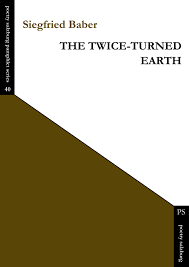 The Twice-Turned Earth
Siegfried Baber
Poetry Salzburg
ISBN: 9783901993855
£7.50 + P&P
The Twice-Turned Earth
Siegfried Baber
Poetry Salzburg
ISBN: 9783901993855
£7.50 + P&P
Is ten years a long time between pamphlets? Technically, Siegfried Baber hasn’t waited that long as there was a “limited edition ebook of poems and photographs” called London Road West in 2020, but that came between his debut pamphlet with Telltale Press, When Love Came To The Cartoon Kid (2015) and his latest, The Twice-Turned Earth (2025). It may then be foolish to suggest a gap of ten years, but the the gap between the two pamphlets is greater than just the span of a decade. Whereas When Love Came…opened with a poem about Lee Harvey Oswald and a sort of Sliding Doors moment, The Twice-Turned Earth opens with something far more meditative.
In ‘Gökotta’ we are told
This is a poem about your favourite word
which is Swedish and has no translation.
This is a poem about making coffee
in a quiet kitchen before it really gets light
and thinking about your favourite word.,
which is Swedish, and according to various sources
expresses the act of waking early to hear
the birds singing at sunrise.
We’ve broken the 4th wall of the book from the very moment we turn to the first poem, or have we? It’s not the poet telling us, the reader, what he’s doing; it’s a communication with a loved one. It’s more of a visual equivalent of John Cage’s 4’11” where we fill in the visual silence with what we see. It’s a poem that’s wrestling with something unattainable. It’s got a sense of trying to be peace offering, a reaching out, and, at the risk of further evoking the hippiness of 60’s singer songwriter Donovan —who gets a mention later in the poem via one of his songs, there’s an interconnectedness at work here despite the way people carry on in their own lanes. No one communicates directly in this poem.
It’s a poem about telephone wires.
It’s a poem about the local station spinning
“Sunshine Superman” while someone’s husband
drinks the milk from his cereal bowl

or someone’s wife smokes her first cigarette
under the chimes on the front step.
And this, I think is a well chosen poem to open this collection, because it’s focus on what can’t be translated, but having a go anyway is a key component so many of the poems that follow it. They contain such sense of unknowingness, of things being just out of reach.
Take, for example, ‘Avebury’, where the poem opens “I can’t be the only one / who remembers / that Pocahontas lunchbox…Later on it states “there must be others / who prayed/ to those strange ancestors / in the village museum”. Further still into the poem he repeats, “No, it can’t just be me / who remembers/ whose seat she saved / on the short coach ride home”
The whole poem is attempting to verify the slightest of details of a childhood love that cumulatively causes a pain to the adult now. This is brought further to life in the poem that follows it, ’Matthew’. It’s a poem about grief for the loss of a childhood friend who died aged thirteen— we don’t find out why, but the reason is never going to be a good, the specifics never pleasant in such. situation, so perhaps that detail is irrelevant. Much like the preceding poem, this looks back at times when a younger Baber would visit Matthew’s house as a kid to look at a “limited edition Han Solo / in its original packaging”. I can picture just such an occurrence and it triggers quite the Proustian rush in me.
Sometimes I’d come round after school
and we’d just look at it together
examining every detail through that small plastic
window — blaster pistol, snow boots
That small plastic window is a way of separating, of having the toy, but not playing with it. The value of it held, but also missed out on by not playing with it. That plastic window also becomes a way of keeping Matthew in his “priceless thirteen years / you remain in pristine condition”.
And while Matthew is kept pristine, those of us on the other side of the plastic are akin to the character in ‘Avebury’ with their fallible memories, as Matthew’s friend finds himself “checking memories / for hallmarks, struggling / to confirm the authenticity of your absence / with an expert’s grown-up eye”. It’s an intensely moving poem, and has that slight breaking of the 4th wall again in it’s last few lines
Like a child several galaxies away
you have left me
kneeling alone on the bedroom floor,
only words to play with.
I think the poet absolutely knows what they are up to here. Yes, they could only talk about the toy at the time, but Baber is well aware he’s also got a poem out of this memory, and the distance, and I for one applaud him for the last line. Is it more honest than opening the book than with “This is a poem..”? It’s debatable, but these are both deliberate acts from a poet in charge of their line and length.
That being in charge extends to little call backs throughout the collection. Avebury makes reference to a blade of grass being knotted round a finger, and we see this motif crop up again towards the end of the book in ‘Cefn Hill’ during a fishing trip.
….Bobby claims he is the third
best fisherman in South Wales, but I refuse
to to believe there could be anyone better.
One summer kneeling among nets and tangled lines,
he knotted a blade of cat-grass
around my little finger, delicate as a dressmaker.
If the poem hadn’t already stated they were using maggots, I’d suggest there was a lovely image of tying a fly there. There still may be, and that it’s whipped across the surface of our minds to catch us—I take great pleasure in rising to the bait.
Fish factor in again in the final poem, ‘Homespun’, where a child has had an excellent day by a river. The child is being implored to teach the adult “to be young again, / how to dress the day with daisy-chains / and tie all the hours together.” This scene feels more inclusive than the scene that opens to pamphlet where everyone is doing heir own thing in that poem. In this one there is a cohesion to the unit. It’s a family for a start, and while ‘’Gökotta’ features a frozen field, this poem ends on a frozen lake. And that’s something I think is worthy of reflection.
I hope Siegfried Baber doesn’t leave it so long between work next time, but if he does I”m intrigued to se how far he leaps forward and if he makes it across the frozen lake.
London Grip Poetry Review – Siegfried Baber
Poetry review – THE TWICE-TURNED EARTH: Mat Riches welcomes another (and possibly overdue) pamphlet from Siegfried Baber
Is ten years a long time between pamphlets? Technically, Siegfried Baber hasn’t waited that long as there was a “limited edition ebook of poems and photographs” called London Road West in 2020, but that came between his debut pamphlet with Telltale Press, When Love Came To The Cartoon Kid (2015) and his latest, The Twice-Turned Earth (2025). It may then be foolish to suggest a gap of ten years, but the the gap between the two pamphlets is greater than just the span of a decade. Whereas When Love Came…opened with a poem about Lee Harvey Oswald and a sort of Sliding Doors moment, The Twice-Turned Earth opens with something far more meditative.
In ‘Gökotta’ we are told
We’ve broken the 4th wall of the book from the very moment we turn to the first poem, or have we? It’s not the poet telling us, the reader, what he’s doing; it’s a communication with a loved one. It’s more of a visual equivalent of John Cage’s 4’11” where we fill in the visual silence with what we see. It’s a poem that’s wrestling with something unattainable. It’s got a sense of trying to be peace offering, a reaching out, and, at the risk of further evoking the hippiness of 60’s singer songwriter Donovan —who gets a mention later in the poem via one of his songs, there’s an interconnectedness at work here despite the way people carry on in their own lanes. No one communicates directly in this poem.
And this, I think is a well chosen poem to open this collection, because it’s focus on what can’t be translated, but having a go anyway is a key component so many of the poems that follow it. They contain such sense of unknowingness, of things being just out of reach.
Take, for example, ‘Avebury’, where the poem opens “I can’t be the only one / who remembers / that Pocahontas lunchbox…Later on it states “there must be others / who prayed/ to those strange ancestors / in the village museum”. Further still into the poem he repeats, “No, it can’t just be me / who remembers/ whose seat she saved / on the short coach ride home”
The whole poem is attempting to verify the slightest of details of a childhood love that cumulatively causes a pain to the adult now. This is brought further to life in the poem that follows it, ’Matthew’. It’s a poem about grief for the loss of a childhood friend who died aged thirteen— we don’t find out why, but the reason is never going to be a good, the specifics never pleasant in such. situation, so perhaps that detail is irrelevant. Much like the preceding poem, this looks back at times when a younger Baber would visit Matthew’s house as a kid to look at a “limited edition Han Solo / in its original packaging”. I can picture just such an occurrence and it triggers quite the Proustian rush in me.
That small plastic window is a way of separating, of having the toy, but not playing with it. The value of it held, but also missed out on by not playing with it. That plastic window also becomes a way of keeping Matthew in his “priceless thirteen years / you remain in pristine condition”.
And while Matthew is kept pristine, those of us on the other side of the plastic are akin to the character in ‘Avebury’ with their fallible memories, as Matthew’s friend finds himself “checking memories / for hallmarks, struggling / to confirm the authenticity of your absence / with an expert’s grown-up eye”. It’s an intensely moving poem, and has that slight breaking of the 4th wall again in it’s last few lines
I think the poet absolutely knows what they are up to here. Yes, they could only talk about the toy at the time, but Baber is well aware he’s also got a poem out of this memory, and the distance, and I for one applaud him for the last line. Is it more honest than opening the book than with “This is a poem..”? It’s debatable, but these are both deliberate acts from a poet in charge of their line and length.
That being in charge extends to little call backs throughout the collection. Avebury makes reference to a blade of grass being knotted round a finger, and we see this motif crop up again towards the end of the book in ‘Cefn Hill’ during a fishing trip.
If the poem hadn’t already stated they were using maggots, I’d suggest there was a lovely image of tying a fly there. There still may be, and that it’s whipped across the surface of our minds to catch us—I take great pleasure in rising to the bait.
Fish factor in again in the final poem, ‘Homespun’, where a child has had an excellent day by a river. The child is being implored to teach the adult “to be young again, / how to dress the day with daisy-chains / and tie all the hours together.” This scene feels more inclusive than the scene that opens to pamphlet where everyone is doing heir own thing in that poem. In this one there is a cohesion to the unit. It’s a family for a start, and while ‘’Gökotta’ features a frozen field, this poem ends on a frozen lake. And that’s something I think is worthy of reflection.
I hope Siegfried Baber doesn’t leave it so long between work next time, but if he does I”m intrigued to se how far he leaps forward and if he makes it across the frozen lake.